The main differences between girls’ and boys’ school blazers lie in the tailoring, fit, structure, sizing, proportions, button orientation, and design style, rather than basic functionality.
According to garment construction principles and school uniform studies referenced by organisations such as the Textile Institute, modern school blazers are designed to strike a balance between comfort, mobility, durability and school identity, while adapting to different body shapes and evolving student preferences.
Manufacturers such as our Eton Kidd now provide modern school blazer solutions that combine traditional uniform standards with ergonomic tailoring, breathable fabrics, sustainable production, and contemporary educational fashion requirements.
Introduction: Understanding the Evolution of the Modern School Blazer
The school blazer is one of the most recognisable symbols of educational uniform and has been so for more than a century. Across the United Kingdom, Australia, Asia, Europe, Africa, and many other countries, blazers continue to represent academic identity, discipline, professionalism, and institutional tradition.
Although school uniforms have evolved significantly over time, the blazer remains central to formal student dress codes because it offers the following benefits:
- Professional appearance
- Weather protection
- School branding
- Student identity
- Uniform consistency
- Long-term durability
Historically, school blazers were heavily influenced by military tailoring and traditional menswear construction. Early designs often prioritised formality and institutional appearance over comfort or ergonomic flexibility.
However, modern school uniform manufacturing has changed dramatically.
Today’s school blazers must satisfy a range of complex requirements, including:
- Comfort during extended wear;
- Student mobility;
- Climate adaptability;
- Gender-inclusive fit options;
- Durability for daily use;
- Easy maintenance;
- Sustainable textile production;
- Contemporary fashion preferences.
As a result, manufacturers are increasingly developing specialised blazer designs optimised for different student body structures and school environments.
One of the most frequently asked questions among parents, students, school administrators, and uniform buyers is:
“What is the difference between a girls’ and boys’ school blazer?”
At first glance, the differences may appear minimal, as both garments share many common features, such as:
lapels, front buttons, pockets, school crests, structured tailoring and formal styling. However, the actual distinctions involve much more than simple appearance.
Modern girls’ and boys’ school blazers may differ in:
| Design Element | Possible Difference |
| Body shaping | Tailored waist structure |
| Shoulder construction | Fit proportions |
| Sleeve cut | Arm mobility |
| Button orientation | Traditional tailoring rules |
| Length | Different style balance |
| Fabric flexibility | Comfort adaptation |
| Chest shaping | Anatomical fit |
| Fashion styling | Contemporary aesthetics |
These differences primarily exist to improve the following:
- Comfort
- Fit accuracy
- Freedom of movement
- Student confidence
- Garment durability
- Overall appearance
At the same time, many modern schools are gradually moving towards gender-neutral uniform policies that reduce the differences in styling between boys’ and girls’ blazers.
This shift reflects broader educational and social changes that emphasise inclusivity, comfort, student choice, functional design, and equality in school dress standards.
Modern suppliers such as Eton Kidd increasingly manufacture school blazers that combine traditional school uniform professionalism with contemporary tailoring technology, ergonomic comfort, durable fabrics, and modern student lifestyle requirements.
Therefore, understanding the differences between girls’ and boys’ school blazers is important for both purchasing decisions and for schools seeking balanced uniform policies that support student comfort, identity and practicality in modern educational environments.
What Is a School Blazer?
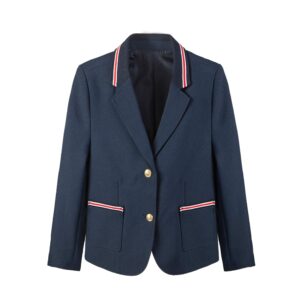
A school blazer is a structured jacket that forms part of a formal educational dress code and is worn by students.
School blazers are traditionally associated with the following types of school:
- Private schools
- Secondary schools
- International schools
- Boarding schools
- Formal academic institutions
However, many public schools also use blazers as part of their official uniform.
The primary purpose of a school blazer is to create a standardised professional appearance, while also reinforcing school identity and institutional culture.
Most school blazers include the following features:
- Structured lapels
- Front fastening buttons
- Chest pockets
- Side pockets
- School badge or embroidered crest
- Lining fabric
- Tailored silhouette
Modern school blazers are produced using a variety of materials, including:
| Fabric Type | Characteristics |
| Polyester blends | Durable and affordable |
| Wool blends | Warm and premium |
| Cotton blends | Breathable comfort |
| Stretch fabrics | Improved mobility |
| Recycled fibers | Sustainable production |
School blazers originated historically from British rowing club jackets in the nineteenth century.
Over time, educational institutions adopted these jackets as symbols of discipline, prestige, and school affiliation.
Today, school blazers remain important because they help schools to maintain the following:
- Uniformity
- A professional appearance
- Institutional branding
- Student identification
- A formal school culture
Modern blazer manufacturing now focuses heavily on balancing tradition with comfort.
Students wear school blazers for many hours each day, so factors such as:
- Breathability
- Flexibility
- Weight
- Climate suitability
- Easy cleaning
Have become increasingly important.
Another major change involves ergonomic tailoring.
Traditional blazers were often rigid and restrictive. Modern designs prioritise student movement and comfort during:
- Classroom activities
- Walking
- Sports transitions
- Public transport
- Daily campus life
Manufacturers such as Eton Kidd are increasingly developing school blazers optimised for modern educational environments through improved tailoring systems, durable fabric engineering and adaptable sizing structures.
The Main Differences Between Girls’ and Boys’ School Blazers
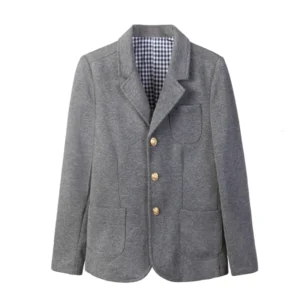
The main differences between girls’ and boys’ school blazers lie in the way they are tailored, the proportions of the body they are designed for, how they are shaped to fit, and their aesthetic style, rather than their core function as a garment.
Both types of blazer generally serve the same purpose in a school uniform.
However, manufacturers traditionally modify construction details to accommodate different average body shapes and styling expectations.
One of the most noticeable differences is waist shaping.
Girls’ school blazers often have a tapered waist to create a fitted silhouette.
Boys’ blazers tend to be straighter through the torso.
The following table summarizes common design differences.
| Feature | Girls’ School Blazer | Boys’ School Blazer |
| Waist shaping | More fitted | Straighter cut |
| Shoulder structure | Narrower shaping | Broader structure |
| Body length | Sometimes shorter | Slightly longer |
| Chest tailoring | Curved contouring | Flat construction |
| Sleeve cut | Slimmer fit | Wider fit |
| Button orientation | May differ traditionally | Standard menswear orientation |
| Overall silhouette | More contoured | More box-shaped |
Historically, button orientation has differed because traditional menswear and womenswear tailoring have followed different fastening conventions.
However, this distinction is increasingly being reduced in modern school uniforms.
Another major difference concerns movement balance.
Girls’ blazers often prioritise:
- Flexibility
- Lightweight structure
- Contoured comfort
Boys’ blazers may emphasise:
- Durability
- Broader shoulder movement
- Straighter posture structure
Fabric stretch technology is increasingly important in both categories.
Modern schools recognise that students require:
- Comfort during long school days;
- Freedom of movement;
- Better climate adaptability.
As a result, many manufacturers now use:
- Stretch polyester blends
- Lightweight linings
- Flexible shoulder construction
- Moisture-control fabrics
Another changing trend is gender-neutral tailoring.
Many schools now offer uniform flexibility, allowing students to choose blazer styles based on personal comfort rather than gender.
This shift reflects evolving educational policies focused on inclusivity and student well-being.
Why Fit Matters in School Blazer Design?
The fit of a school blazer is one of the most important factors affecting its performance, appearance, durability, and the comfort of the student wearing it.
Poorly fitted blazers may cause the following issues:
- Restricted movement
- Fabric stress
- Premature wear
- Student discomfort
- Negative self-image
Because students wear school blazers daily for extended periods, ergonomic tailoring significantly affects long-term usability.
The body structures of girls and boys often develop differently during adolescence, which influences how manufacturers design blazer proportions.
For example:
Shoulder width, chest shaping, waist structure, sleeve mobility, and back length may require different tailoring approaches.
Modern school blazer design is increasingly focused on movement ergonomics.
The following areas receive particular attention:
| Ergonomic Area | Design Purpose |
| Shoulder mobility | Backpack movement |
| Arm flexibility | Writing comfort |
| Waist shaping | Natural body movement |
| Ventilation | Temperature regulation |
| Sleeve structure | Reduced restriction |
The introduction of stretch fabric technology has dramatically improved the comfort of school blazers.
Traditional, rigid woven fabrics often restricted students’ mobility.
Modern blended fabrics now offer the following benefits:
- Better elasticity;
- Wrinkle resistance;
- Shape retention;
- Reduced garment stress.
Another important factor is growth accommodation.
Children and teenagers grow rapidly, so school blazers must balance a tailored appearance with the capacity to be adjusted to fit different sizes.
Manufacturers are increasingly incorporating features such as:
- Expandable seams;
- Flexible panels;
- Growth-friendly proportions.
This extends the garment’s lifespan.
Companies such as Eton Kidd are focusing more and more on combining formal school aesthetics with ergonomic tailoring systems that support durability and everyday student comfort.
Fabric and Construction Differences in Modern School Blazers
The manufacturing of modern school blazers involves far more advanced textile engineering than many consumers realise.
Historically, school blazers were made almost entirely from wool.
Today, modern school uniform fabrics prioritise the following:
- Durability
- Easy maintenance
- Breathability
- Lightweight wear
- Sustainability
- Wrinkle resistance
Most modern school blazers use blended fabrics.
Common material combinations include:
| Material Blend | Advantages |
| Polyester-viscose | Durability and softness |
| Wool-polyester | Warmth and resilience |
| Stretch polyester | Flexibility |
| Recycled polyester | Sustainability |
| Cotton blends | Breathability |
Although girls’ and boys’ blazers may be made from identical fabrics, they differ slightly in their construction techniques.
Girls’ blazers may incorporate the following:
- Softer shoulder padding
- More flexible interfacing
- Curved seam shaping
Boys’ blazers may prioritise:
- Stronger structure
- Straighter drape
- Reinforced shoulder support
Climate adaptability has become increasingly important.
Schools in warmer regions increasingly require:
- Lightweight linings
- Moisture management
- Breathable weaves
Another important trend is sustainable school uniform production.
Modern consumers increasingly seek:
- Recycled materials
- Eco-friendly dyes
- Ethical manufacturing
- Long-lasting garments
As sustainability becomes central to global apparel manufacturing, school blazer suppliers continue to invest in environmentally responsible production systems.
How Is School Blazer Fashion Changing?
The traditional style of the school blazer has evolved considerably over the past decade.
Historically, school uniforms emphasised strict formal conformity.
Modern students and parents increasingly value:
- Comfort;
- A contemporary appearance;
- Personal confidence;
- Functional design.
As a result, school blazers are becoming more fashion-conscious while still maintaining an air of institutional professionalism.
Current design trends include:
- Slimmer silhouettes
- Lightweight construction
- Stretch fabrics
- Softer tailoring
- Minimal bulk
- Better ventilation
The rise of hybrid educational environments has also influenced uniform expectations.
Students now frequently transition between:
- Classrooms
- Outdoor activities
- Transportation
- Digital learning spaces
This requires blazers that can support diverse daily movement patterns.
Another major trend is gender-neutral uniform policies.
Many schools are increasingly reducing visual distinctions between girls’ and boys’ blazers.
This shift reflects a broader social emphasis on:
- Inclusivity;
- Student flexibility;
- Reduced gender stereotyping.
Another growing trend involves sustainable manufacturing.
Modern school uniform suppliers are increasingly marketing blazers that feature:
- Recycled polyester
- Durable construction
- An extended wear lifespan
- Eco-friendly packaging
Manufacturers such as Eton Kidd are adapting to these evolving market demands by developing school blazers that combine traditional academic presentation with modern textile engineering, comfort-focused tailoring and contemporary educational fashion standards.
Choosing the Right School Blazer
Selecting the right school blazer requires careful consideration of factors beyond appearance alone.
Parents and schools should consider the following:
- Fit
- Quality
- Fabric durability
- Climate suitability
- Maintenance requirements
- Growth flexibility
- Comfort
- School compliance
The following table outlines important buying considerations.
| Buying Factor | Why It Matters |
| Fabric durability | Daily wear resistance |
| Stretch comfort | Student mobility |
| Proper fit | Better appearance and comfort |
| Easy maintenance | Practical cleaning |
| Breathability | Temperature comfort |
| Reinforced seams | Longer lifespan |
| Sustainable materials | Environmental responsibility |
Another important consideration is sizing flexibility.
As students often experience rapid growth, slightly adjustable sizing systems can help garments last longer.
Climate also matters significantly.
Schools in warm regions may prioritise:
- Lightweight fabrics
- Minimal lining
- Breathable weaving
Cold-weather schools may prefer:
- Wool blends
- Heavier construction
- Insulated lining
Another major factor is student confidence.
Comfortable, properly fitted school blazers can improve:
- Daily wear satisfaction
- Classroom confidence
- Professional appearance
As school uniforms continue to evolve globally, the selection of modern school blazers increasingly focuses on balancing institutional identity with practical student comfort and long-term garment value.
FAQ About School Blazers
- What is the difference between girls’ and boys’ school blazers?
The main differences involve fit, tailoring, waist shaping, shoulder structure, and silhouette rather than core functionality.
- Are girls’ school blazers more fitted?
Yes. Girls’ blazers often feature a more contoured waist and a slimmer silhouette.
- Can girls wear boys’ school blazers?
In many schools, yes. Modern uniform policies increasingly allow students to choose styles based on comfort and preference.
- Why do school blazers have different button orientations?
Traditional menswear and womenswear tailoring historically used opposite button orientations, though modern school uniforms increasingly minimize this distinction.
- What fabrics are best for school blazers?
Polyester-viscose blends, wool blends, and stretch fabrics are commonly used for durability, comfort, and easy maintenance.
- Are modern school blazers more comfortable than older styles?
Yes. Modern school blazers increasingly use ergonomic tailoring, lightweight fabrics, and stretch materials for improved comfort and mobility.
Conclusion
Although girls’ and boys’ school blazers serve the same fundamental purpose within educational uniform systems, there are important differences in terms of tailoring, silhouette, fit, structure, and ergonomic design. Girls’ blazers tend to have a more contoured waist, a slimmer cut and flexible styling elements, whereas boys’ blazers traditionally have a straighter silhouette, broader shoulders and slightly more structured tailoring. However, the modern school uniform industry is moving increasingly towards more inclusive, comfort-focused designs that reduce rigid gender distinctions, prioritising student mobility, confidence and practicality.
Advancements in textile engineering, stretch fabrics, breathable materials, and ergonomic garment construction have significantly improved the comfort and functionality of modern school blazers compared to traditional uniform styles. Today’s students require garments that can support them through long school days, active movement, changing climates and evolving educational environments, all while maintaining a professional academic appearance and institutional identity.
Manufacturers such as Eton Kidd are adapting to these changing market expectations by developing high-quality school blazers that combine traditional uniform professionalism with modern tailoring technology, durable materials, sustainable production practices and student-centred comfort. As educational fashion continues to evolve globally, the future of school blazers will likely focus even more on flexibility, inclusivity, sustainability, and functional design, while preserving the timeless academic identity that blazers have represented for generations.