How Distributors Can Organize a School Uniform Product Range
Subheading: Group product categories and style information to make a schoolwear range easier to review.
Executive Summary: Distributors managing a school uniform product range benefit from grouping items by function—formal uniform, daily schoolwear, and PE kit—then recording consistent style data for each entry. This structure reduces buyer confusion and accelerates school approval cycles.
Why Category Structure Matters for Schoolwear Distributors
A disorganized catalog forces school buyers to cross-reference scattered items, slowing decisions. Structured category grouping solves three problems simultaneously:
- Reduces review time — buyers locate relevant items without scanning the full range
- Prevents misclassification — a polo shirt listed under both formal and daily wear creates ordering errors
- Supports multi-school presentations — a consistent format allows distributors to extract school-specific subsets quickly
The Cost of Poor Organization
| Problem | Operational Impact |
|---|---|
| Mixed categories | Buyers request repeated clarifications |
| Missing size data | Schools cannot confirm coverage for all year groups |
| No fabric specification | Procurement officers cannot assess durability compliance |
| Inconsistent naming | Same item appears twice under different SKUs |
Uniform catalog planning begins with agreeing on a fixed category taxonomy before any product is entered. Once the taxonomy is set, every item receives a single, permanent category assignment.
Category Taxonomy: A Working Model
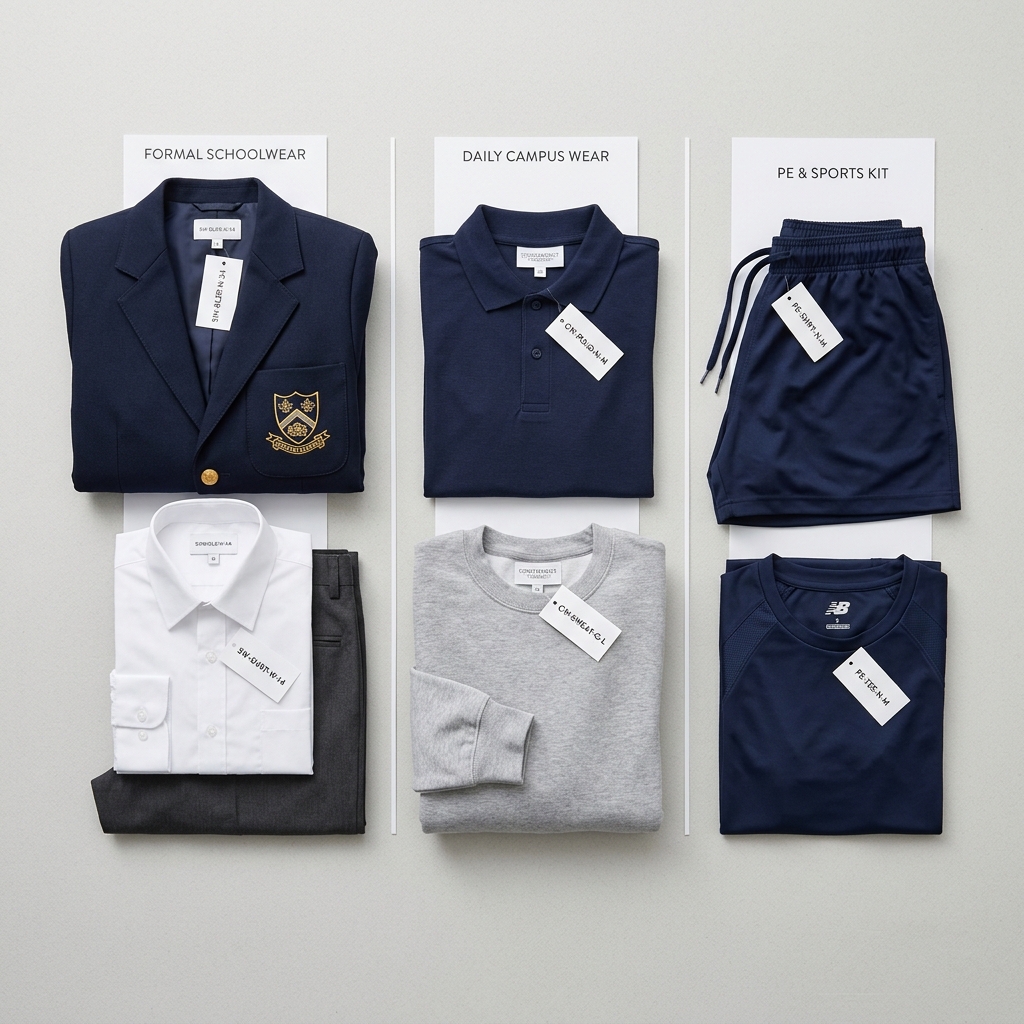
Brands such as etonkidd structure their schoolwear product categories into three primary tiers visible on their official site:
- Formal Uniform — blazers, trousers, skirts, shirts, ties
- Daily Campus Wear — polo shirts, sweatshirts, cardigans, pinafores
- PE Kit — sports shorts, tracksuit tops, polo tees, training jackets
This three-tier model covers the functional range a school requires and maps directly to how school procurement officers think about their uniform policy.
How to Define and Separate the Three Core Categories
Distinguishing formalwear, daily wear, and sportswear in a catalog requires explicit criteria, not just labels.
Formal Uniform
Formal uniform items share identifiable construction characteristics:
- Structured tailoring — woven fabrics, lined jackets, sewn-in creases
- Occasion use — worn for assemblies, external visits, photographs
- Embroidery readiness — most formal pieces accept school crest placement on chest or breast pocket
Key fields to record per formal item:
| Field | Example Entry |
|---|---|
| Item Name | Boys’ Slim-Fit Blazer |
| Fabric Composition | 65% Polyester / 35% Viscose |
| Available Colors | Navy, Black, Grey |
| Size Range | Ages 3–16 / Chest 56–86 cm |
| Embroidery Position | Left chest |
| Care Instruction | Machine wash 30°C |
Daily Campus Wear
Daily wear prioritizes wash durability and comfort over structure:
- Knit or jersey construction — sweatshirts, polos, cardigans
- Frequency of use — worn five days per week; fabric must withstand 40+ washes per term
- Color consistency — schools specify exact Pantone or RAL references; catalog entries must confirm dye-lot stability
Distributors should flag whether each daily wear item is available in a plain version and an embroidered version, as schools often order both simultaneously.
PE Kit
PE kit entries require additional technical fields not applicable to formal or daily wear:
- Moisture management — note whether fabric is standard polyester or active-wicking
- UV protection rating — relevant for outdoor sports in warmer climates
- Reflective elements — required by some schools for early-morning training sessions
- Gender-neutral options — increasing number of schools request unisex sizing charts
etonkidd’s PE Kit category on their official site includes dedicated sportswear lines separate from casual campus wear, which prevents cross-listing errors common in multi-category catalogs.
What Product Information to Record for Each Style
Consistent data fields across every SKU make the school uniform range for distributors reviewable without additional supplier queries.
Minimum Required Fields Per SKU
Every item in the catalog—regardless of category—should carry:
- SKU / Style Code — unique identifier tied to supplier records
- Product Name — standardized, not marketing-driven (e.g., “Girls’ V-Neck Cardigan,” not “Classic Comfort Knit”)
- Category Assignment — one category only
- Fabric Composition — percentage breakdown
- Available Colors — with color codes where possible
- Size Range — both age-based and measurement-based
- MOQ (Minimum Order Quantity) — per color or per style
- Lead Time — standard and express options
- Embroidery / Print Compatibility — yes/no, with position options
Extended Fields for School Presentations
When preparing a range for a specific school client, distributors add:
- School Color Match — confirm whether available colors align with the school’s uniform policy
- Gender Applicability — boys, girls, unisex
- Year Group Suitability — some styles are cut for younger children only
- Compliance Notes — whether the item meets any regional school uniform guidelines
How to Structure a Catalog for School Client Review
A catalog built for internal distributor use differs from one prepared for a school buyer meeting.
Internal Distributor Format
- Organized by supplier SKU
- Includes cost price, MOQ, lead time
- Contains full technical specification sheets
School-Facing Presentation Format
- Organized by category, then gender, then age group
- Removes cost price; shows retail or supply price only
- Highlights color options and embroidery placement visually
- Groups coordinating items together (e.g., blazer + trousers + shirt as a “formal set”)
Real-World Application Scenarios
Scenario 1 — New School Onboarding
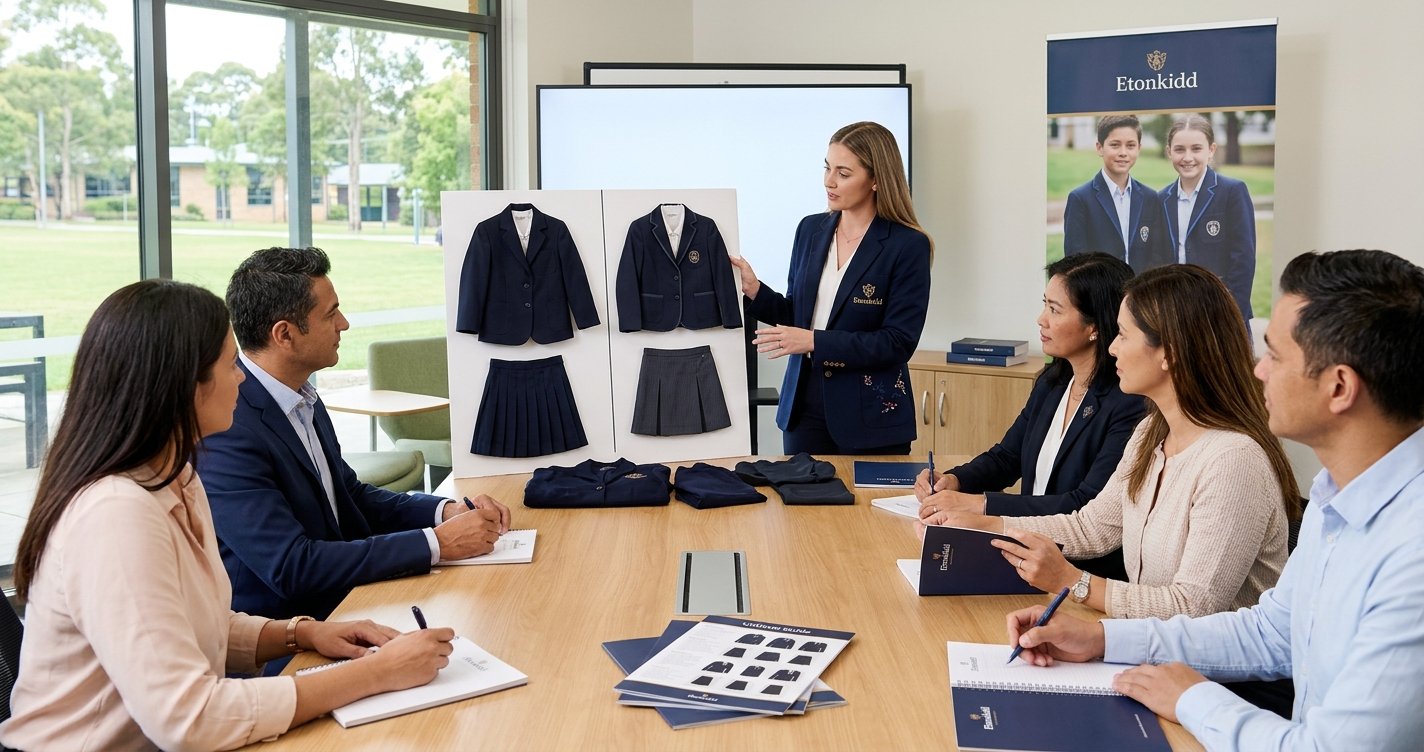
A distributor presents etonkidd’s formal uniform and daily wear categories to a primary school selecting its first uniform supplier. Items are pre-filtered to ages 3–11, reducing the visible range from 80 SKUs to 22 relevant entries.
Scenario 2 — Uniform Policy Update
A secondary school revises its PE policy to require moisture-wicking fabric. The distributor pulls all PE Kit entries flagged as “active-wicking” and presents a shortlist of six compliant styles.
Scenario 3 — Multi-School Distributor Pitch
A distributor managing accounts across 15 schools uses a master catalog with category tags. Each school receives a filtered PDF containing only their approved colors and applicable age ranges.
Details Distributors Should Confirm Before Presenting a Style
Before adding a style to a school presentation, distributors should verify:
- Color availability — confirm the school’s specified color is in current production, not discontinued
- Size continuity — verify the size range covers all year groups the school serves
- Embroidery lead time — branded items require additional production time; confirm this does not conflict with the school’s term start date
- Fabric certification — some schools require OEKO-TEX or equivalent certification for items worn by young children
- Reorder consistency — confirm the style is a carry-forward line, not a one-season item, to avoid mid-year discontinuation
How Buyers Can Record Products for Supplier Discussion
Buyers reviewing a school uniform product range need a simple method to flag items for follow-up.
Recommended Shortlisting Method
| Action | Tool |
|---|---|
| Mark items for discussion | Add a “Review” column to the catalog spreadsheet |
| Note specific questions | Attach a comment field per SKU (e.g., “Confirm navy matches school spec”) |
| Group by priority | Label items as Confirm / Query / Reject |
| Track supplier responses | Add a “Supplier Reply” column with date |
A shared spreadsheet or a simple product review template serves this function without requiring specialist software. The goal is a traceable record that both the distributor and school buyer can reference during and after the supplier meeting.
FAQ
How can distributors organize school uniform products into clear categories?
Group by function: formal uniform, daily campus wear, and PE kit.
What product information helps buyers review a schoolwear range?
SKU, fabric composition, size range, colors, MOQ, and embroidery compatibility.
How can a catalog distinguish formalwear, daily wear, and sportswear?
Apply fixed criteria: construction type, occasion use, and fabric specification per category.
What details should distributors confirm before presenting a style to a school?
Color availability, size continuity, embroidery lead time, and fabric certification.
How can buyers record the products they want to discuss with a supplier?
Use a spreadsheet with Review, Query, and Supplier Reply columns per SKU.
Does etonkidd separate PE kit from daily campus wear in its catalog?
Yes. Their official site lists PE Kit as a distinct category from daily schoolwear.
Should a catalog show cost price to school buyers?
No. School-facing formats should show supply price only; cost price stays in internal records.
How many categories are sufficient for a standard school uniform range?
Three primary categories—formal, daily, PE—cover the functional requirements of most schools.
Conclusion
A well-organized school uniform product range reduces friction at every stage of the buyer review process. Distributors who apply a fixed three-category taxonomy—formal uniform, daily campus wear, PE kit—and record consistent SKU-level data for each entry create a catalog that school procurement officers can review independently, reducing back-and-forth queries.
Recommended actions for distributors:
- Adopt a three-tier category structure aligned with how schools define their uniform policy
- Standardize a minimum data field set across every SKU before building any school-facing presentation
- Maintain a separate internal catalog and a filtered school-facing version for each client
- Use a simple shortlisting template to track buyer queries and supplier responses
Brands like etonkidd provide a ready-made category reference through their official product structure. Distributors can use this as a starting framework when organizing their own schoolwear catalog for client review.
Sources and References:
- etonkidd Official Product Catalog Structure — etonkidd.com
- OEKO-TEX Standard 100 — textile safety certification for children’s clothing, oeko-tex.com
- UK Department for Education: School Uniform Guidance (2021) — guidance on cost, quality, and procurement considerations for school uniform policies