What to Include in a School Uniform Catalog Request
Share clear product and project details when requesting a school uniform catalog.
Tags: School Uniforms | Catalog | Buyer Resources
Executive Summary
When requesting a school uniform product catalog, providing structured context — buyer type, product categories, target market, and project scale — helps suppliers match the right materials to your needs. Clear requests reduce back-and-forth and accelerate sourcing timelines.
Why a Structured Catalog Request Matters
A school uniform catalog serves as a reference framework, not a binding commitment. Suppliers use request details to:
- Filter relevant product lines by buyer segment
- Prioritize applicable fabric weights and construction specs
- Align schoolwear catalog for buyers with regional compliance requirements
Key principle: The more context you provide, the more targeted the catalog response.
| Request Quality | Typical Response Time | Catalog Relevance |
|---|---|---|
| No context provided | 5–10 business days | Generic, broad |
| Buyer type only | 3–5 business days | Partially filtered |
| Full project brief | 1–3 business days | Highly targeted |
Suppliers handling institutional volume — schools, distributors, or private-label brands — process dozens of catalog inquiries weekly. Structured requests move to the front of the queue.
Section 1: Identify Your Buyer Type
Why Buyer Classification Affects Catalog Content
Different buyer types require different product emphases within a school uniform product catalog.
| Buyer Type | Primary Need | Catalog Focus |
|---|---|---|
| School / Institution | Compliance, durability | Daily wear, PE, formalwear |
| Distributor / Reseller | SKU range, MOQ flexibility | Full category breadth |
| Uniform Brand / OEM | Branding, fabric specs | Private label, custom options |
| Procurement Agent | Price tiers, delivery | Bulk SKUs, lead time data |
Actionable steps:
- State your buyer type explicitly in the first line of your request
- Indicate whether you represent a single school or a multi-school network
- Specify if you operate domestically or across international markets
Misclassified buyer types result in catalog sections that don’t apply to your procurement model, wasting review time on both sides.
Section 2: Define Your Target Product Categories
Mapping Uniform Categories to Your Program Needs
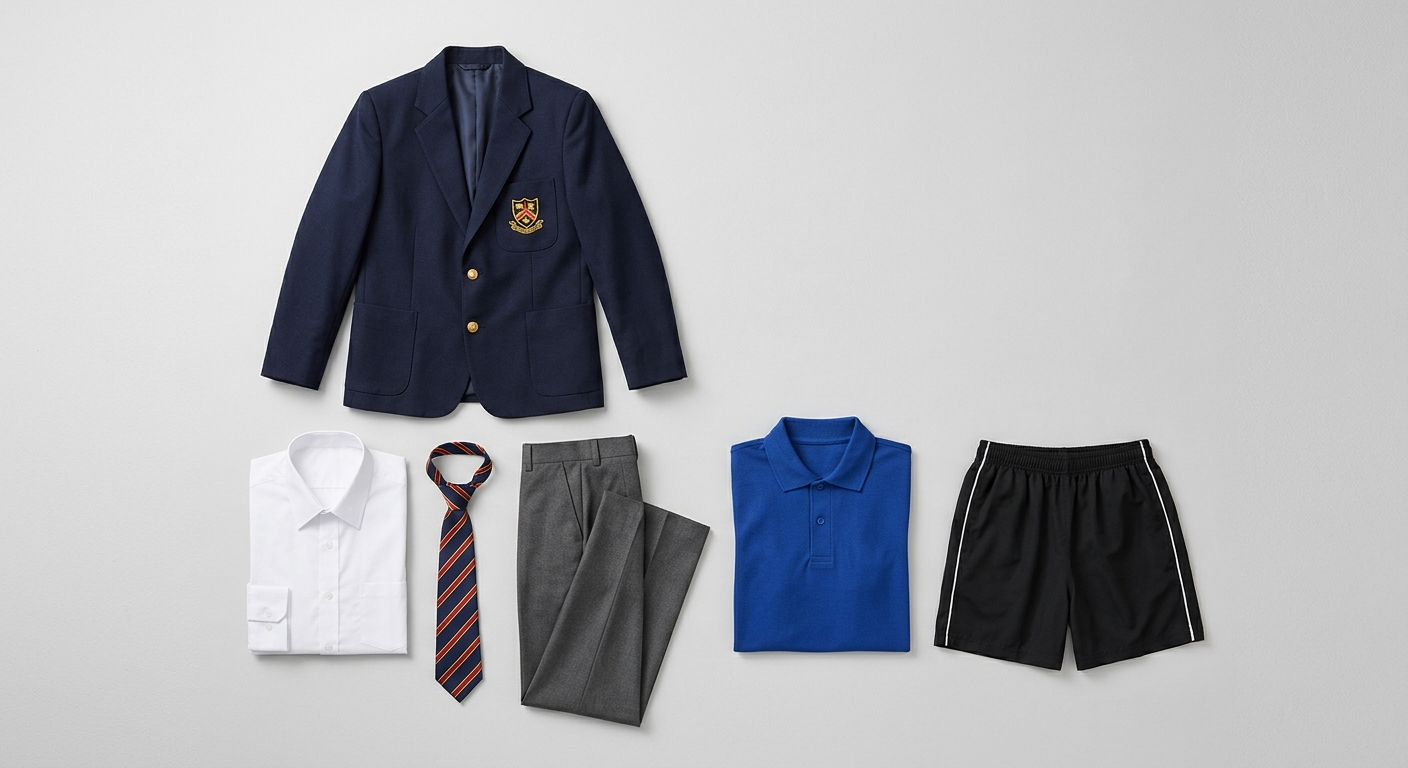
A school uniform catalog typically organizes products across three functional tiers. Knowing which tier you need prevents catalog overload.
Tier 1 — Formalwear:
- Blazers, dress shirts, ties, formal trousers/skirts
- Typically used for ceremonies, school photos, administrative contexts
Tier 2 — Daily Wear:
- Polo shirts, chinos, pinafores, cardigans
- Core volume category; highest annual reorder frequency
Tier 3 — PE & Sportswear:
- Track suits, shorts, moisture-wicking tops, sports socks
- Often governed by separate procurement cycles
| Category | Typical Use Context | Reorder Frequency |
|---|---|---|
| Formalwear | Ceremonies, enrollment | Annual or biannual |
| Daily Wear | Year-round school days | Termly or annual |
| PE / Sportswear | Physical education, sports day | Annual |
In your catalog request, specify:
- Which of the three tiers applies to your program
- Whether you need all tiers or a single focused category
- Any cross-category bundling requirements (e.g., full uniform sets)
This directly determines whether the school uniform styles presented are relevant to your procurement scope.
Section 3: Describe Your Target Market and End Users
Geographic and Demographic Context
Target market details shape fabric selection, sizing standards, and compliance requirements in any schoolwear catalog for buyers.
Provide the following where known:
- Country or region: Climate directly influences fabric weight (tropical vs. temperate)
- School type: Public, private, international, religious institution
- Student age range: Infant (2–5), junior (6–11), senior (12–18)
- Gender configuration: Mixed, single-gender, or non-binary sizing required
- Annual student volume: Approximate number of uniform sets per cycle
Why this matters:
- Sizing grids vary significantly between Asian, European, and North American standards
- Some markets require specific certifications (e.g., OEKO-TEX, CPSC compliance for children’s wear)
- Climate-appropriate fabric weights prevent product returns and reorder friction
Suppliers cannot optimize a school uniform catalog without knowing the end-user demographic. Even approximate data is more useful than none.
Section 4: Outline Your Project Background and Timeline
Contextualizing Scale and Urgency
Project background transforms a generic catalog inquiry into a qualified sourcing request.
Include in your request:
- Project stage: Exploratory research, active sourcing, or confirmed budget
- Estimated order volume: Number of units or sets per cycle
- Target delivery window: Academic calendar start dates, tender deadlines
- Budget range (optional): Price tier guidance helps suppliers filter premium vs. standard lines
- Existing supplier relationship: New inquiry or re-sourcing from a previous vendor
Example project brief structure:
“We are a distributor supplying 12 private schools in Southeast Asia. We source approximately 8,000 uniform sets annually across daily wear and PE categories. We are evaluating suppliers for the upcoming academic year starting August. Budget is mid-tier.”
This level of detail allows a supplier to prepare a school uniform product catalog response that matches your actual procurement parameters — not a generic brochure.
Timeline alignment table:
| Project Stage | Recommended Lead Time for Catalog Request |
|---|---|
| Exploratory (6–12 months out) | Request full category catalog |
| Active sourcing (3–6 months out) | Request category-specific catalog |
| Confirmed budget (1–3 months out) | Request catalog + pricing inquiry simultaneously |
Section 5: Real-World Application Scenarios
Use Case 1 — International School Network
A procurement manager oversees uniform sourcing for 6 international schools across three countries. Their catalog request includes:
- Buyer type: Multi-school procurement agent
- Categories: Formalwear + daily wear (PE handled separately)
- Market: Mixed climate zones, ages 4–18
- Volume: ~15,000 sets annually
- Timeline: 9 months to next academic cycle
Result: Supplier delivers a filtered school uniform catalog covering relevant product lines, sizing standards for each region, and applicable certifications.
Use Case 2 — Private Label Uniform Brand
A startup uniform brand seeks a manufacturing partner. Their request includes:
- Buyer type: OEM / private label brand
- Categories: Full range (all three tiers)
- Market: Domestic, premium segment, ages 6–16
- Volume: Initial run of 2,000 sets
- Branding: Custom woven labels, pantone-matched colors
Result: Supplier routes the request to the appropriate product development team rather than the standard distribution catalog workflow.
Use Case 3 — Regional Distributor
A distributor expanding into a new province requests a catalog to assess range breadth:
- Buyer type: Reseller / distributor
- Categories: Daily wear focus, PE secondary
- Market: Public schools, ages 6–12
- Volume: Unknown (exploratory phase)
- Priority: MOQ thresholds and delivery lead times
Result: Supplier provides a schoolwear catalog for buyers that emphasizes inventory availability, standard MOQs, and logistics terms.
FAQ
What information should I provide when requesting a school uniform catalog?
Buyer type, product categories, target market, student age range, and approximate order volume.
Can I request a catalog for specific uniform categories?
Yes. Specify formalwear, daily wear, or PE — or request all three tiers.
Should I share my buyer type and target market?
Yes. Both fields determine which school uniform styles and specs are shown.
Can a catalog include formalwear, daily wear, and PE products?
Catalogs can cover all three tiers; state which apply to your program.
How can I ask which products or styles are currently available?
Submit a catalog request with your project brief; availability details follow from the supplier.
Do I need confirmed budget figures to request a catalog?
No. Budget range is optional but helps filter product tiers.
Is a catalog request the same as placing an order?
No. A catalog request is a non-binding information inquiry.
Can distributors request a different catalog format than schools?
Yes. Buyer type classification routes requests to the appropriate catalog version.
Conclusion and Next Steps
A well-structured catalog request reduces sourcing friction and produces more relevant results. The core elements — buyer type, product categories, target market, and project timeline — give suppliers the context needed to respond with a focused school uniform product catalog rather than a generic document.
Professional recommendation: Before submitting any catalog request, prepare a one-paragraph project brief covering all four elements above. This single step measurably improves catalog relevance and supplier response quality.
To request a catalog or submit a product inquiry, visit Etonkidd’s catalog request page and include your project brief directly in the inquiry form.
References and Standards
- ISO 139: Textiles — Standard atmospheres for conditioning and testing
- OEKO-TEX Standard 100: Chemical safety certification for children’s textiles
- CPSC 16 CFR Part 1615/1616: US flammability standards for children’s sleepwear
- BS EN 13402: European size designation standards for clothing
- ASTM D5034: Standard test method for breaking strength of textile fabrics