How to Run a School Uniform Design Review
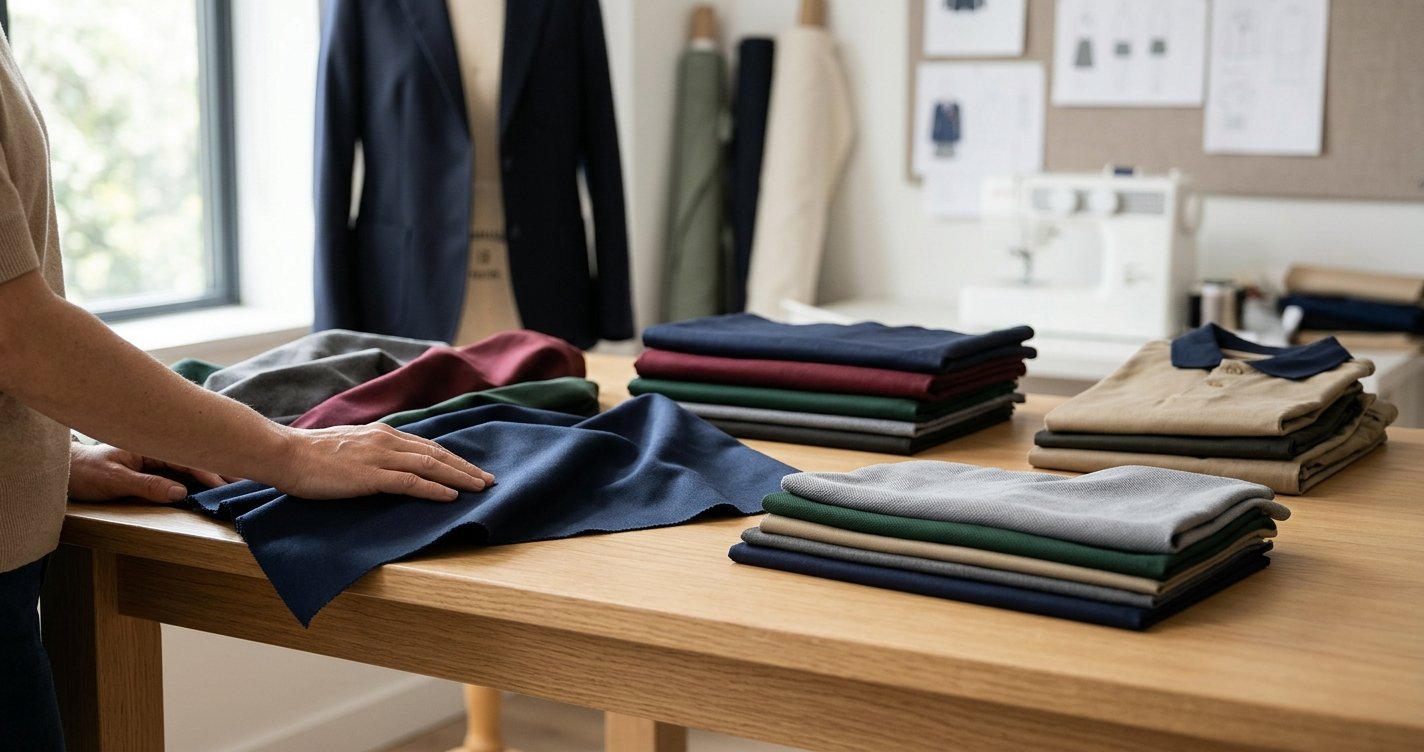
Use a clear discussion process to review design preferences and school identity before making decisions.
Executive Summary
A school uniform design review is a structured process for gathering stakeholder input, comparing design options, and documenting decisions before committing to a supplier or style. This guide provides a repeatable discussion framework for school administrators managing a uniform redesign or new uniform planning project.
What Is a School Uniform Design Review?
A design review is a facilitated discussion — not a final decision meeting. Its purpose is to surface preferences, identify constraints, and align stakeholders on what the school wants to evaluate further.
Key distinctions:
- A review collects input; it does not approve a design
- It separates aesthetic preferences from functional requirements
- It creates a documented record for supplier briefings
When to run one:
| Trigger | Typical Timeline Before Launch |
|---|---|
| New school opening | 12–18 months prior |
| Existing uniform redesign | 6–12 months prior |
| Supplier change only | 3–6 months prior |
| Policy update (e.g., adding items) | 2–4 months prior |
Schools using etonkidd’s planning resources typically initiate a design review at the start of the procurement cycle, before any supplier is contacted.
Who Should Be Involved in a School Uniform Review?
Participation scope affects both the quality of input and the legitimacy of the final decision.
Core Decision Group
- Principal or Head of School
- Business Manager or Procurement Lead
- Relevant Department Heads (PE, pastoral, senior leadership)
Advisory Contributors
- Parent representatives (e.g., Parent Association committee)
- Student council representatives (age-appropriate involvement)
- Administrative staff who handle uniform queries
Optional Specialists
- Brand or communications staff (if school identity guidelines exist)
- External uniform consultant or supplier representative (invited only after internal alignment)
Recommended group size: 5–10 people for the core review session. Larger groups slow consensus. Separate surveys can capture broader input from parents and students before the meeting.
Participation matrix:
| Role | Decision Authority | Input Method |
|---|---|---|
| Principal | Final approval | Live discussion |
| Business Manager | Budget constraints | Live discussion |
| Parent Rep | Advisory | Pre-meeting survey |
| Student Rep | Advisory | Pre-meeting survey |
| Supplier | Information only | Post-review briefing |
What Should a School Discuss During a Uniform Design Review?
Structure the discussion across four topic areas. Allocate roughly 15–20 minutes per area.
1. School Identity and Visual Direction
This section is not about choosing a style — it is about articulating what the school currently communicates visually and what it wants to communicate.
Discussion prompts:
- What words describe how the school presents itself to the community?
- Are there existing brand guidelines, colors, or logo standards that must be respected?
- Are there design elements in the current uniform that should be retained, and why?
- Are there elements the school wants to move away from?
Document responses as preference statements, not design mandates. Example: “We prefer a more contemporary silhouette but have no fixed view on collar style.”
2. Functional and Practical Requirements
Checklist to confirm:
- Year levels and garment types required (e.g., Prep–Year 12, sport vs. formal)
- Climate and seasonal considerations
- Activity-specific needs (labs, workshops, outdoor programs)
- Durability expectations (wash cycles, fabric weight preferences)
- Accessibility requirements (adaptive closures, sensory considerations)
3. Budget and Procurement Parameters
- Target per-student cost range
- Whether a single supplier or multi-supplier model is preferred
- In-school shop vs. third-party retail distribution
- Timeline for rollout (phased or full replacement)
4. Stakeholder Feedback Already Collected
Before the review meeting, distribute a short survey to parents and students. Bring summarized results into the room.
Suggested survey questions:
- What do you like about the current uniform?
- What would you change?
- What is most important to you: durability, appearance, comfort, or cost?
How to Compare Different Uniform Design Ideas
Once preferences are documented, the school can request concept options from suppliers. Use a structured scoring approach to compare them objectively.
Design Comparison Framework
Create a simple scoring table. Rate each option from 1–5 across agreed criteria.
| Criteria | Weight | Option A | Option B | Option C |
|---|---|---|---|---|
| Alignment with school identity | 25% | 4 | 3 | 5 |
| Functional suitability | 25% | 5 | 4 | 3 |
| Estimated per-student cost | 20% | 3 | 5 | 4 |
| Stakeholder preference score | 20% | 4 | 3 | 4 |
| Supplier lead time & reliability | 10% | 4 | 4 | 3 |
| Weighted Total | 100% | 4.0 | 3.7 | 3.9 |
Notes on using this table:
- Adjust weights to reflect your school’s actual priorities
- Use the same criteria across all supplier submissions
- Do not score options before seeing physical samples where possible
Physical Sample Review
Before scoring, request garment samples. Evaluate:
- Fabric hand-feel and weight
- Stitching quality at stress points
- Color accuracy against school palette
- Fit across a range of body types
etonkidd recommends schools review a minimum of two supplier sample sets before shortlisting.
How to Record Decisions Made During a Review
A design review produces three types of outputs: confirmed decisions, working preferences, and open items requiring further information.
Review Documentation Template
After each session, complete a one-page summary covering:
Section 1 — Confirmed Decisions
Items the group has agreed on and will not revisit without a formal change request.
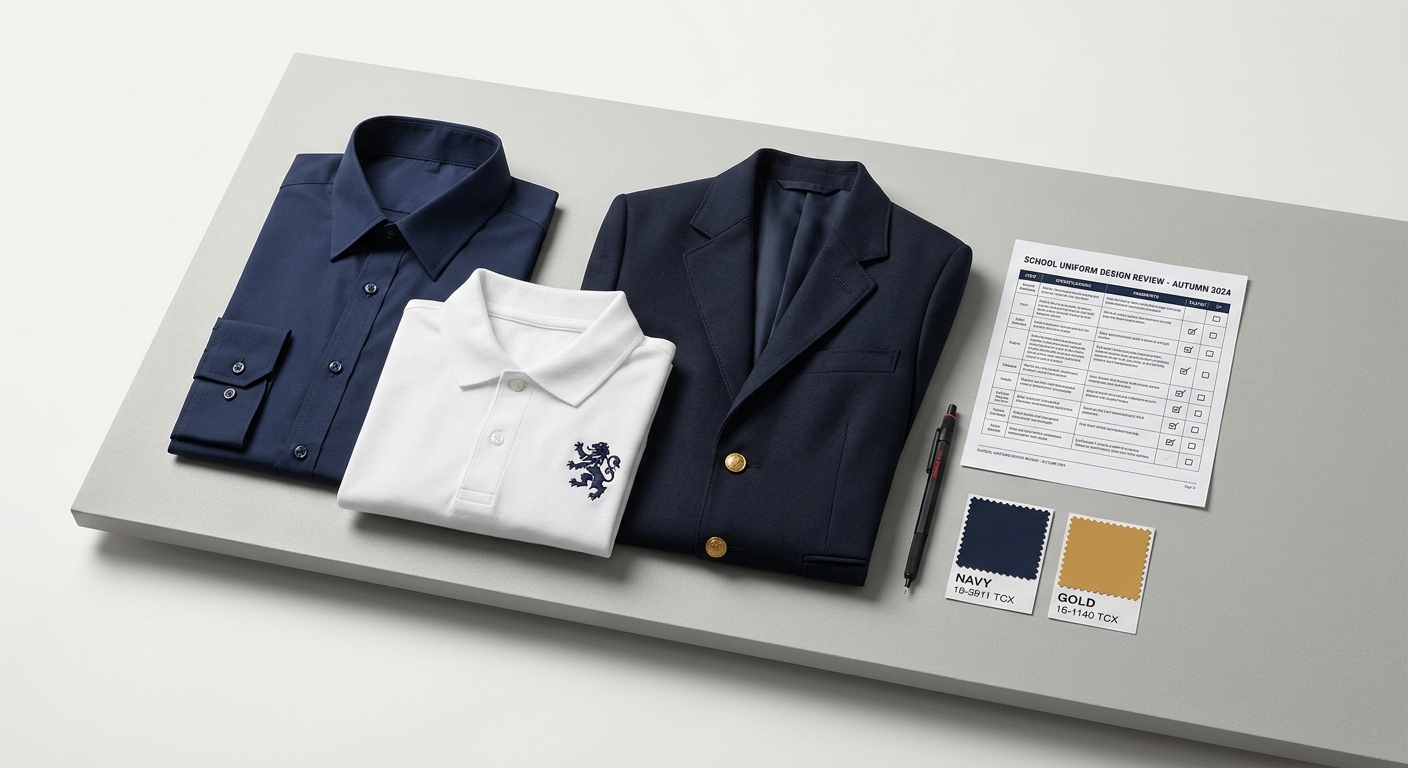
Example: School colors confirmed as navy and gold. PE uniform to remain separate from formal uniform.
Section 2 — Working Preferences
Directions the group leans toward but has not finalized.
Example: Preference for a structured collar on the senior formal shirt, pending sample review.
Section 3 — Open Items
Questions that cannot be answered without additional data, supplier input, or stakeholder consultation.
| Open Item | Information Needed | Owner | Due Date |
|---|---|---|---|
| Budget per student | Finance team to confirm envelope | Business Manager | [Date] |
| Parent cost sensitivity | Survey results pending | Admin Lead | [Date] |
| Fabric durability standard | Supplier spec sheets required | Procurement Lead | [Date] |
Distribution: Share the summary with all review participants within 48 hours. Use it as the briefing document when approaching suppliers.
Real-World Application Scenarios
Scenario 1 — New Independent School (Opening in 14 months)
The principal convenes a five-person review group. A parent survey is distributed two weeks prior. The review covers identity, garment scope, and budget. Three suppliers including etonkidd are briefed using the documented output. Sample review scheduled for month three.
Scenario 2 — Established School Updating Sport Uniform Only
A narrower review focuses solely on functional requirements and cost. Two staff members and one parent rep participate. Decision timeline is compressed to six weeks. One open item (fabric moisture management standard) is resolved via supplier data sheet before final selection.
Scenario 3 — School Responding to Parent Feedback on Costs
The review is triggered by a parent petition. The group prioritizes cost and durability criteria. Survey data from 120 parent responses is brought into the session. The output document includes a clear record of which concerns were addressed and which remain under review.
FAQ
What should a school discuss during a uniform design review?
Identity alignment, functional needs, budget parameters, and existing stakeholder feedback.
Who may be involved in a school uniform review?
Principal, business manager, parent reps, and student reps in an advisory role.
How can a school compare different uniform design ideas?
Use a weighted scoring table across agreed criteria, applied after reviewing physical samples.
What feedback can be collected before choosing a design?
Parent and student surveys on current uniform satisfaction, priorities, and cost sensitivity.
How can a school record the decisions made during a review?
A one-page summary with confirmed decisions, working preferences, and open items with owners.
How long does a school uniform design review take?
A single structured session runs 90–120 minutes, plus pre-meeting survey time.
When should a school start a uniform design review?
At minimum six months before the intended rollout date; 12 months is preferred for full redesigns.
Does etonkidd provide review support tools?
etonkidd offers planning templates and sample sets to support the school’s internal review process.
Conclusion
A school uniform design review is a practical planning tool, not a design exercise. Its value lies in aligning stakeholders early, documenting preferences clearly, and creating a structured brief that suppliers can respond to accurately.
Core recommendations:
- Separate the internal review from supplier engagement
- Collect parent and student input via survey before the live session
- Document all outputs in three categories: confirmed, preferred, and open
- Use a weighted scoring table when comparing supplier options
- Request physical samples before finalizing any scoring
Schools working through a school uniform redesign or initial school uniform planning project can use this process regardless of design direction or supplier. The goal is a clear, auditable record that supports good decisions — not a prescribed outcome.
For planning templates and sample request information, visit etonkidd.com.
Tags: Uniform Design · School Planning · Buyer Resources
Related topics: school uniform design review · school uniform redesign · school uniform design ideas · school uniform planning
Sources and reference standards: ISO 9001 procurement documentation practices; general education procurement guidelines from independent school associations; supplier briefing best practices as documented in B2B procurement literature.