How to Choose School Uniform Fabric for Climate, Comfort and Care
Compare fabric options by how the garments will be worn, washed and used throughout the school year.
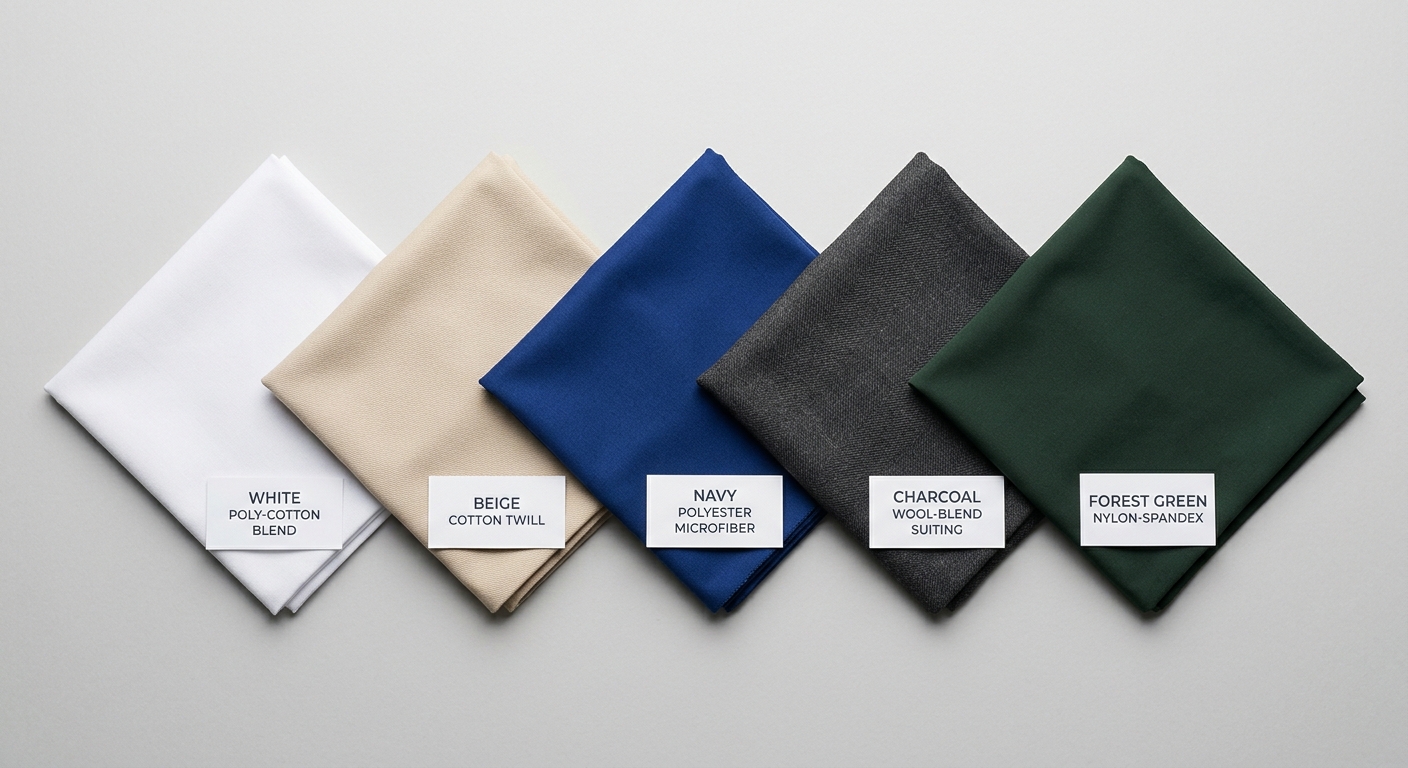
Executive Summary: School uniform fabric selection depends on three variables: local climate, physical activity level, and institutional laundering capacity. Polyester-cotton blends (65/35) dominate global procurement due to balanced durability and cost, but no single fabric suits every garment category or climate zone.
1. Why Fabric Selection Determines Uniform Program Success
Uniform programs fail most often at the fabric level—not the design level. A garment that shrinks after 10 washes, pills under backpack straps, or traps heat in subtropical classrooms generates parent complaints and replacement costs within one academic year.
The three procurement errors most buyers make:
- Selecting fabric by price per meter without calculating cost-per-wear
- Applying one fabric specification across all garment categories
- Ignoring regional humidity and UV exposure data during sourcing
What fabric selection actually controls:
- Thermal comfort during 6–8 hours of daily wear
- Dimensional stability across 50–100+ wash cycles per year
- Color retention under repeated industrial laundering
- Resistance to abrasion at collar, cuffs, and seat areas
School uniform fabric durability is not a single metric—it is the intersection of tensile strength (measured in Newtons per ASTM D5034), pilling resistance (Martindale cycles), and colorfastness rating (ISO 105-C06). Buyers who specify only GSM (grams per square meter) without these secondary metrics consistently under-specify.
2. Core Fabric Options: Technical Comparison
2.1 Polyester-Cotton Blend (65/35 or 80/20)
The most widely used school uniform fabric globally.
- GSM range: 180–220 gsm for shirts; 240–280 gsm for trousers and skirts
- Tensile strength: 450–600 N (warp direction, ASTM D5034)
- Pilling resistance: 3,000–5,000 Martindale cycles
- Shrinkage after 5 washes: <2% when pre-shrunk
- Colorfastness (ISO 105-C06): Grade 4–5
Best for: Shirts, blouses, trousers, skirts in temperate and subtropical climates.
Limitation: Poor moisture-wicking in high-humidity environments above 75% RH.
2.2 100% Cotton (Plain Weave or Twill)
- GSM range: 140–180 gsm (shirts); 260–300 gsm (trousers)
- Breathability: High—moisture vapor transmission rate (MVTR) 800–1,200 g/m²/24h
- Shrinkage risk: 3–8% without pre-shrink treatment
- Pilling resistance: 1,500–2,500 Martindale cycles
- Colorfastness: Grade 3–4 (fades faster than poly-cotton under UV)
Best for: Hot, dry climates; primary school age groups with sensitive skin.
Limitation: Higher maintenance burden; requires ironing; shorter garment lifespan at 40–50 washes.
2.3 Polyester Microfiber and Performance Fabrics
Increasingly specified for fabric for school PE uniforms and sports days.
- GSM range: 120–160 gsm
- Moisture-wicking: Moves 2–3× more moisture than cotton per unit time
- Drying time: 40–60% faster than cotton equivalents
- UV protection: UPF 30–50 achievable with yarn treatment
- Pilling resistance: 4,000–8,000 Martindale cycles
Best for: PE kits, outdoor activity uniforms, tropical school environments.
Limitation: Static buildup; microplastic shedding per wash cycle (environmental consideration).
2.4 Wool and Wool Blends
- GSM range: 260–340 gsm (blazers and winter trousers)
- Natural temperature regulation: Active in both cold and mild conditions
- Odor resistance: Lanolin content inhibits bacterial growth
- Care requirement: Dry clean or 30°C wool cycle only
- Cost index: 3–5× higher than poly-cotton per meter
Best for: Blazers, winter formal uniforms in cold climates (below 10°C average).
3. Fabric Performance Comparison Table
| Fabric Type | GSM Range | Durability (Martindale) | Breathability | Wash Cycles Before Degradation | Relative Cost |
|---|---|---|---|---|---|
| 65/35 Poly-Cotton | 180–280 | 3,000–5,000 | Medium | 80–120 | Low |
| 100% Cotton | 140–300 | 1,500–2,500 | High | 40–60 | Low–Medium |
| Polyester Microfiber | 120–160 | 4,000–8,000 | High (wicking) | 100–150 | Medium |
| Wool / Wool Blend | 260–340 | 2,000–4,000 | High (thermal) | 20–30 (gentle) | High |
| Nylon-Cotton Blend | 200–260 | 5,000–7,000 | Medium | 100–130 | Medium |
4. How Climate Should Drive Fabric Selection
Climate is the primary filter before any other specification. Applying temperate-zone fabric standards to tropical schools is one of the most common procurement errors in institutional uniform buying.
4.1 Tropical and High-Humidity Climates (>75% RH, >28°C)
- Priority: Moisture management over durability weight
- Recommended: 65/35 poly-cotton at 160–180 gsm, or polyester microfiber
- Avoid: Heavy twill cotton above 260 gsm; wool in any category
- Key spec: MVTR above 800 g/m²/24h; quick-dry finish
4.2 Temperate Climates (10–25°C, Variable Humidity)
- Priority: Balanced comfort across seasons
- Recommended: 65/35 poly-cotton at 200–220 gsm; wool blazers for winter term
- Key spec: Colorfastness Grade 4+ for year-round color retention
4.3 Cold Climates (<10°C Average Winter Temperature)
- Priority: Thermal retention and layering compatibility
- Recommended: Wool-blend trousers (280–320 gsm); fleece-lined PE layers
- Key spec: Thermal resistance (CLO value) above 0.5 for outer layers
| Climate Zone | Shirt Fabric | Trouser/Skirt Fabric | PE Uniform Fabric | Blazer Fabric |
|---|---|---|---|---|
| Tropical (>28°C) | Poly-cotton 160 gsm | Poly-cotton 200 gsm | Microfiber 130 gsm | Lightweight poly-blend |
| Temperate | Poly-cotton 200 gsm | Poly-cotton 240 gsm | Microfiber 150 gsm | Wool-blend 280 gsm |
| Cold (<10°C) | Cotton-rich 200 gsm | Wool-blend 300 gsm | Fleece 200 gsm | Wool 320 gsm |
5. Fabric Care, Washing, and Institutional Laundry Requirements
Procurement teams that ignore laundry infrastructure create uniform programs that degrade within one term.
Key questions buyers must ask before finalizing fabric:
- What is the school’s laundry temperature standard? (Most institutional machines run 60–90°C; cotton and wool behave differently at these temperatures.)
- Is laundering done at home or centrally? Home washing introduces variable agitation and detergent concentrations.
- What is the expected wash frequency? Daily PE kit washing requires fabric rated for 150+ cycles.
- Does the school use chlorine-based bleach? Chlorine degrades polyester faster than cotton; specify colorfastness to hypochlorite (ISO 105-N01) separately.
Care label standards to specify:
- ISO 3758 (GINETEX care symbols) for international programs
- ASTM D3136 for North American institutional buyers
- Minimum Grade 4 colorfastness to washing (ISO 105-C06)
- Maximum 2% dimensional change after 5 washes (ISO 5077)
Fabric finishes that extend care performance:
- Durable press / wrinkle-resistant resin finish: Reduces ironing requirement by 60–70%
- Soil-release finish: Improves stain removal at lower wash temperatures
- Anti-microbial treatment: Relevant for PE uniforms; reduces odor between washes
6. Matching Fabric to Garment Category
No single fabric is optimal across all uniform items. Procurement should segment by garment function.
| Garment | Primary Requirement | Recommended Fabric | Avoid |
|---|---|---|---|
| Dress shirt / blouse | Appearance retention | 65/35 poly-cotton, 180–200 gsm | 100% linen (high crease) |
| Trousers / skirt | Abrasion resistance | Poly-cotton twill, 240–260 gsm | Lightweight cotton (<180 gsm) |
| Blazer / jacket | Structure + thermal | Wool-blend or poly-wool, 280–320 gsm | 100% polyester (poor drape) |
| PE shirt | Moisture management | Polyester microfiber, 130–150 gsm | Cotton (slow drying) |
| PE shorts | Stretch + durability | Nylon-spandex blend (87/13) | Woven cotton |
| Sweater / pullover | Thermal comfort | Cotton-acrylic blend, 280–320 gsm | 100% acrylic (pilling) |
7. FAQ: School Uniform Fabric Selection
How do you choose fabric for school uniforms?
Prioritize climate zone, wash frequency, and garment function before selecting fiber type or GSM.
Which factors affect school uniform comfort?
Breathability (MVTR), fabric weight (GSM), fiber softness, and seam construction.
How should climate influence uniform fabric selection?
Tropical climates need low-GSM wicking fabrics; cold climates require higher CLO-value materials.
What should buyers ask about fabric care and washing?
Confirm wash temperature, bleach type, and cycle frequency before specifying colorfastness grades.
Is one fabric suitable for every school uniform item?
No. PE uniforms require microfiber; blazers require wool-blend; shirts require poly-cotton.
What is the best fabric for school uniforms overall?
65/35 polyester-cotton blend at 180–240 gsm covers the widest range of climates and use cases.
What GSM is standard for school uniform trousers?
240–280 gsm poly-cotton twill is the institutional standard for durability and shape retention.
How many wash cycles should school uniform fabric withstand?
A minimum of 80 cycles without significant color loss or dimensional change is the baseline specification.
Conclusion and Procurement Recommendations
The best fabric for school uniforms is not a single material—it is a specification matrix aligned to climate, garment type, and laundry infrastructure.
Core recommendations:
- Use 65/35 poly-cotton (180–240 gsm) as the default for shirts, blouses, and trousers in temperate zones
- Specify polyester microfiber for all PE and sports uniform categories regardless of climate
- Require ISO 105-C06 Grade 4+ colorfastness and ISO 5077 dimensional stability testing on all bulk orders
- Segment fabric specifications by garment category—never apply one fabric standard across an entire uniform program
- Request wash-test data (minimum 50-cycle report) from suppliers before committing to bulk production
Uniform programs that apply these criteria consistently reduce replacement costs by 20–35% over a three-year cycle and generate measurably fewer parent complaints related to comfort and appearance.
Sources and Standards Referenced:
- ASTM D5034: Standard Test Method for Breaking Strength and Elongation of Textile Fabrics
- ISO 105-C06: Colorfastness to Domestic and Commercial Laundering
- ISO 5077: Textiles — Determination of Dimensional Change in Washing and Drying
- ISO 3758: Textiles — Care Labelling Code Using Symbols
- ASTM D3136: Standard Terminology Relating to Fabric Defects
- Martindale Abrasion Test (ISO 12947-2): Pilling and Abrasion Resistance
- GINETEX International Association for Textile Care Labelling