Quick Answer
There is no single best school uniform brand for every student, because the right choice depends on durability, comfort, fit, price, school requirements, and whether the buyer needs individual retail garments or customized bulk production.
What Makes a School Uniform Brand “Best”?
The phrase ‘best school uniform brand’ sounds simple, but actually involves several different criteria. Parents may focus on whether a shirt feels comfortable, fits correctly, can withstand repeated washing, and remains affordable as their children grow. However, a school or distributor has a broader procurement problem, as it needs consistent fabric colours, reliable sizing, custom embroidery, school-specific designs, stable production capacity, predictable lead times, and replacement garments that remain visually consistent with previous batches.
This is why a brand that works well for an individual family is not necessarily the same one that makes sense for a school-wide uniform programme. Retail schoolwear generally relies on standardised products and sizes, whereas institutional uniform programmes can involve custom patterns, school colours, logos, labels, packaging and scheduled replenishment. The UK Department for Education’s guidance on school uniform costs specifically advises schools to prioritise affordability and value while also considering quality, durability and sustainability.
It is also important to distinguish between lowest price and best value. For example, a £5 polo shirt may have a lower purchase price than a £9 alternative, but if the cheaper garment needs to be replaced more frequently, the initial saving may not represent a lower total cost. Conversely, a premium brand name does not automatically make a uniform better. A useful evaluation considers the entire ownership cycle, including purchase price, durability, comfort, washing requirements, replacement frequency, and availability.
Which School Uniform Brands Are Commonly Considered by Parents?
For families purchasing ready-made school uniforms, large, well-established retailers can be appealing due to their combination of broad availability, standardised sizing, and relatively straightforward returns. In the 2026 Which? investigation, 3,062 parents were surveyed, and various factors were evaluated, including value for money, quality, durability, comfort, fit, appearance, and practicality.
These results should be interpreted in context rather than as a universal ranking of every school uniform manufacturer worldwide. The survey reflects the experiences of parents who shopped with the retailers included in the research, and the most suitable supplier can vary according to a school’s uniform policy and the type of garment required. A retailer that performs well for generic shirts and trousers, for example, may not necessarily provide the exact blazer, badge, tie, sportswear or custom garment required by a particular school.
Price is another reason why the answer varies. In the UK market, supermarket and value retailers compete strongly on basic schoolwear, particularly during back-to-school promotions.
For this reason, parents should distinguish between retail convenience and uniform specialisation. While a general retailer may be ideal for plain polo shirts or trousers, a specialist supplier may be necessary when the school requires a specific colour, crest, embroidery, fabric or garment construction.

What Should You Look for in a High-Quality School Uniform?
A good school uniform should be reliable in the conditions that children actually experience. Students may wear the same garments repeatedly, wash them frequently, sit, kneel, play sports, carry backpacks, and move between indoor and outdoor environments. Therefore, the uniform needs to strike a balance between comfort, durability, ease of care, appearance, and price.
One of the first specifications to examine is fabric composition. Cotton, polyester, cotton-polyester blends, recycled polyester, performance fabrics and other textile constructions offer different combinations of breathability, moisture management, abrasion resistance, colour retention and care requirements. There is no universally superior fibre because the most suitable material depends on the garment and climate. For example, a summer polo shirt and a winter blazer have very different performance requirements.
Construction quality is equally important. Consider seam strength, stitching density, buttons, zippers, hems, collar construction, pocket reinforcement, and how school badges are attached. For trousers and skirts, areas exposed to repeated movement should be sufficiently reinforced. Shirts need collars and cuffs that retain their shape after repeated laundering. While these details may not be obvious when a garment is new, they become important after several months of regular use.
The UK’s Department for Education specifically identifies durability as a relevant factor when schools assess the quality and value of uniforms. This is important because uniform procurement is not simply a fashion decision, but a practical one involving repeated use over an academic year.
School Uniform Brand Comparison: What Matters Most?
Instead of asking which brand is universally best, buyers can compare brands according to the characteristics that matter most to their particular situation. The following framework is useful for both individual parents and school procurement teams.
| Evaluation Factor | Why It Matters | What to Check |
| Fabric quality | Affects comfort, durability, and appearance | Fiber composition, weight, hand feel |
| Fit and sizing | Children need freedom of movement | Size chart, cut, age range, adjustment features |
| Durability | Uniforms experience repeated wear and washing | Seams, fabric strength, color retention |
| Comfort | Garments may be worn for many hours | Breathability, softness, construction |
| Price | Determines initial purchasing cost | Unit price and complete uniform cost |
| Washability | Schoolwear is frequently laundered | Care instructions, shrinkage, colorfastness |
| Availability | Important when children outgrow garments | Stock depth and size availability |
| Customization | Essential for many schools | Embroidery, badges, colors, labels |
| Replenishment | Students need replacement items throughout the year | Repeat-order capability |
| Sustainability | Increasingly relevant to school procurement | Material sourcing, durability, repair/reuse options |
This approach also explains why customer reviews should not be used as the only source of information. A review can tell you that a particular garment feels comfortable, but it may not provide technical information about fabric weight, production consistency, or long-term availability. For institutional purchasing, a sample, technical specification sheet, factory audit, and repeat-production history can be more useful than a large number of anonymous reviews.
Is a More Expensive School Uniform Better?
Not necessarily. While price and quality are related for some products, school uniforms are a good example of why the relationship is not always straightforward. Manufacturing costs depend on factors such as fabric, labour, garment construction, branding, logistics, retail margins, order quantity, and more. While a higher retail price may reflect better materials or construction, it could also reflect branding, distribution costs, or a more specialised sales channel.
The most useful measure is value over the garment’s useful life. For example, suppose one pair of trousers costs $20 and another costs $30. If both remain usable for the same period and perform similarly, the cheaper garment may be the better option. However, if the $20 garment wears out quickly while the $30 garment remains usable for substantially longer, the cost difference needs to be evaluated against how often it will need replacing.
This principle is especially important for school uniforms because children grow quickly. A garment can remain structurally sound while becoming too small in a relatively short space of time. In that situation, buying the most expensive product available may not provide proportional financial benefits.
Schools also have to consider accessibility. The UK Department for Education recommends that school uniform policies take affordability into account, noting that schools should avoid placing an unnecessary financial burden on families. Therefore, uniform programmes need to balance quality and longevity with realistic household budgets.

Retail School Uniform Brands vs. Direct Manufacturers
A major distinction that is often overlooked in discussions about the “best” school uniform brand is the difference between retail brands and manufacturers. A parent buying three shirts has different needs from a school purchasing 3,000 shirts.
Retail brands provide convenience. Consumers can often purchase standard sizes online or in stores, compare products quickly, return unsuitable garments, and buy small quantities without meeting a minimum order. This model is particularly practical for individual families.
Direct manufacturers operate differently. They can produce large quantities according to an agreed specification and may offer OEM, ODM, or private-label services. This can allow a school, distributor, or uniform brand to specify fabric composition, garment colors, patterns, logos, labels, packaging, and other details. The trade-off is that manufacturers generally require larger quantities, planning, samples, and more detailed technical specifications.
| Buyer Type | Usually Important | Appropriate Supply Model |
| Individual parent | Price, fit, convenience, availability | Retailer or school-approved shop |
| Small school | Customization, price, delivery | Specialist supplier or manufacturer |
| Large school group | Consistency, capacity, replenishment | Direct manufacturer or institutional supplier |
| Uniform distributor | MOQ, margins, customization | Manufacturer / OEM supplier |
| Schoolwear brand | Product development, private label | OEM / ODM manufacturer |
| International importer | Factory price, quality, logistics | Direct manufacturer |
Therefore, the “best brand” question has to be matched to the buyer. A well-known consumer brand may be highly convenient for individual purchasing, while a manufacturing partner may be more relevant to organizations developing an entire school uniform collection.
Why Manufacturer Selection Matters for Customized School Uniforms?
When a school requires its own colours, crest, embroidery, or garment designs, the supplier’s manufacturing capability is more important than brand recognition. The uniform needs to look consistent across thousands of students, and replacement garments ordered months later must be compatible with the original specifications.
When it comes to bulk procurement, I would evaluate a school uniform manufacturer based on a combination of factors, including sample quality, fabric specification, production capacity, customisation capability, minimum order quantity (MOQ), quality control, lead time, and repeat-order consistency. A factory quotation should also clarify whether the cost of embroidery, labels, packaging, sampling, and other customisation services is included or charged separately.
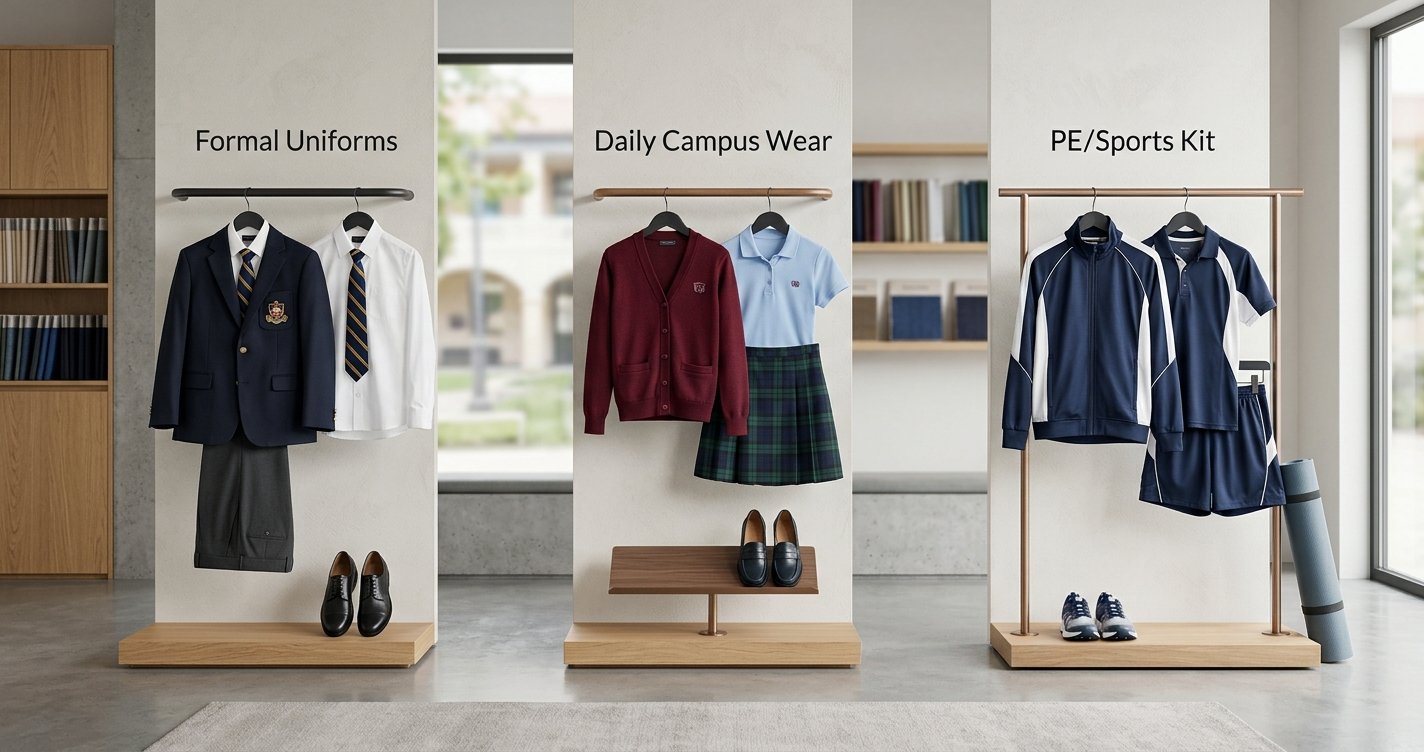
Eton Kidd is one supplier to consider for schools, distributors, and brands looking for a manufacturing partner. It presents itself as a school uniform manufacturer offering OEM/ODM/OBM services, with schoolwear categories including formal uniforms, daily campus wear, sports and PE uniforms, seasonal products, and accessories. Its published manufacturing information states an annual production capacity of over 10 million items and provides MOQ information for customised and in-stock bulk orders.
This manufacturing model serves a different purpose from buying an individual school shirt from a retail chain. The relevant questions for a school or distributor are whether the supplier can maintain the required specifications across production batches, meet delivery schedules, provide appropriate samples, and support future replenishment without making unnecessary changes to the fabric, colour, or construction.
How Important Are Comfort and Durability?
Comfort and durability are two of the most important practical characteristics of school uniforms because they are worn frequently. Students may wear the same polo shirt or trousers several times a week, so the feel of the fabric, breathability, seam construction and resistance to repeated washing are much more important than they would be for occasional clothing.
Comfort is particularly important in warm climates or in schools with long periods of outdoor activity. A garment that feels acceptable during a short fitting session may become uncomfortable after several hours of classroom activity. The wearing experience can be influenced by factors such as fabric weight, fibre blend, moisture behaviour, garment looseness, collar construction and seam placement.
Durability has a similarly practical meaning. It does not simply mean that a garment survives a laboratory strength test, but rather that the uniform continues to look and function acceptably after repeated washing and normal school use. Whitson’s 2026 research specifically considered durability, comfort, fit, quality, appearance, practicality and value for money when evaluating school uniform retailers, demonstrating that parents consider uniforms to have multiple dimensions rather than focusing solely on price.
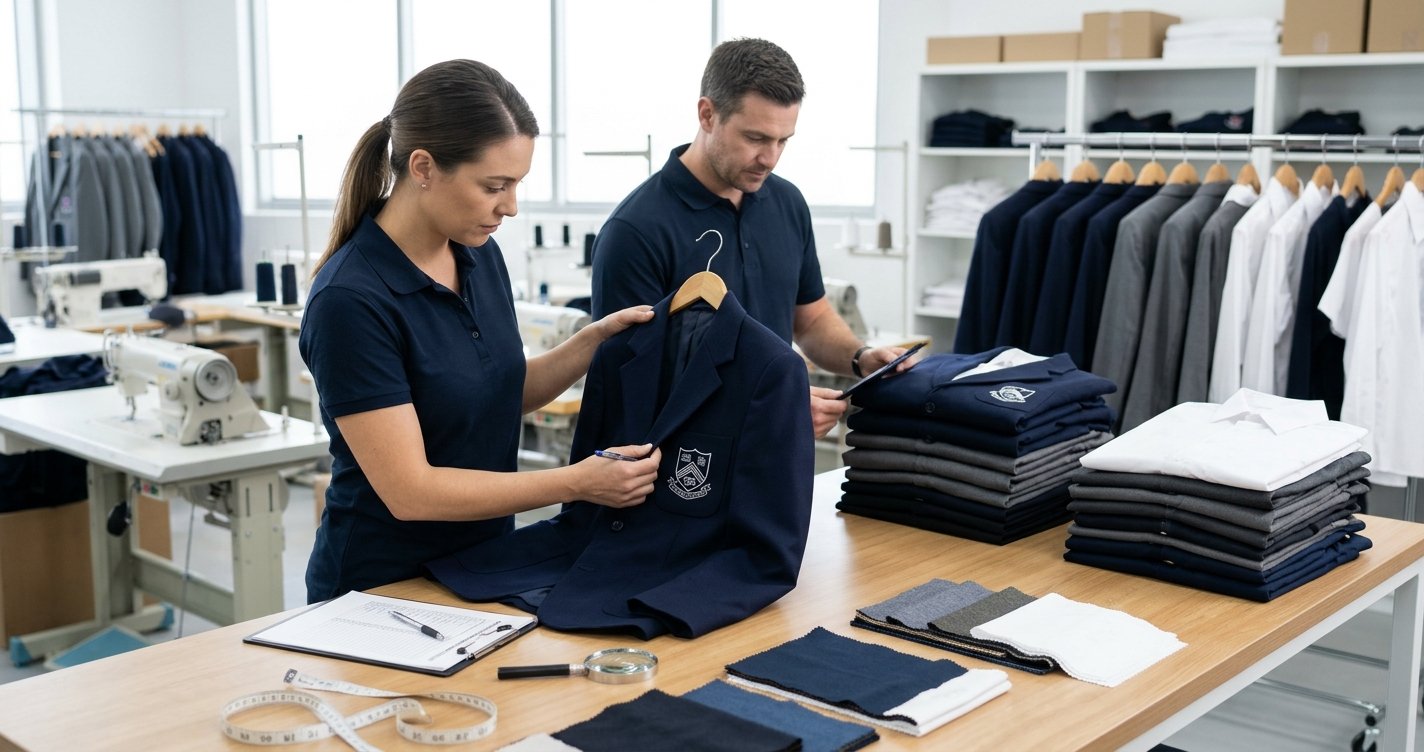
Ideally, procurement teams should test these characteristics through physical samples and, where appropriate, washing and wear trials. While a technical specification can describe a fabric, actual garment performance also depends on pattern construction, sewing quality, finishing, and production control.
How Can You Choose the Right School Uniform Brand?
The most reliable method is to define the purchasing requirements before comparing brands. For an individual family, this means identifying the school’s mandatory items, approved colors, logo requirements, required quantity, available budget, and expected period of use. For a school or distributor, the process should begin with a technical specification covering fabric, measurements, colors, trims, branding, packaging, order volume, delivery schedule, and quality requirements.
Next, compare suppliers using the same criteria. Do not compare a premium branded blazer with an inexpensive generic blazer without accounting for fabric, construction, school branding, and intended use. Likewise, do not compare a retail price with a factory quotation without accounting for MOQ, shipping, customization, and other procurement costs.
It is also useful to separate mandatory requirements from preferences. A school may require a particular shade, badge, or fabric specification, while features such as packaging style or optional accessories may be negotiable. This separation can reveal where meaningful cost savings are available without changing the core uniform identity.
Finally, consider the entire supply cycle. A good school uniform program needs not only an acceptable first shipment but also dependable replacement stock. Students change sizes throughout the academic year, new students arrive, garments become damaged, and schools may need additional inventory unexpectedly. Supplier reliability therefore becomes part of the product itself.

FAQ: School Uniform Brands
- Which school uniform brand is best?
There is no universal best school uniform brand because the right choice depends on price, fit, comfort, durability, school requirements, and purchasing method. For UK retail shoppers, recent research evaluated these factors and found strong customer scores for M&S and Next among the retailers included in its survey.
- What is the best material for a school uniform?
The best material depends on the garment, climate, activity level, and required durability. Cotton blends and polyester-based fabrics are commonly used because manufacturers can balance comfort, durability, color retention, and care requirements.
- Are expensive school uniforms better quality?
Not necessarily. Price should be compared with fabric quality, construction, durability, comfort, and expected service life rather than treated as a direct measure of quality.
- What makes a school uniform durable?
Durability depends on fabric performance as well as stitching, seams, buttons, zippers, reinforcement, and overall garment construction. Proper washing and care also have a major effect on how long a uniform remains usable.
- Can schools buy uniforms directly from manufacturers?
Yes. Schools and distributors can work directly with manufacturers when order volumes and customization requirements justify factory production. Direct manufacturing can support customized fabrics, colors, logos, labels, packaging, and repeat-order programs.
- What should schools look for in a school uniform supplier?
Schools should compare quality, price, MOQ, production capacity, lead time, customization, quality control, sustainability considerations, and replacement-order capability. A supplier’s ability to maintain consistent specifications across multiple production batches is particularly important for long-term uniform programs.
Conclusion
The question ‘Which brand of school uniform is best?’ does not have a single, universal answer because school uniforms cater to different buyers with different requirements. For parents buying ready-made uniforms, factors such as fit, comfort, durability, price, availability and customer service are important; for schools, distributors and uniform brands, factors such as manufacturing capacity, customisation, quality consistency, minimum order quantity (MOQ), logistics and long-term replenishment can be equally important.
Therefore, the most useful way to choose a school uniform brand is to compare the complete value proposition rather than the brand name alone. Retail brands can be convenient for individual purchases, while specialist manufacturers such as Eton Kidd are relevant when a school or distributor requires customised uniforms on a large scale. Ultimately, the most suitable supplier is one whose product specifications, quality, price, service capacity, and supply model align with the uniform programme’s actual requirements.