How to Prepare a Product List for a School PE Kit
Subheading: Organize PE kit categories and project details into a clear list for discussion.
Executive Summary: A well-structured PE kit product list helps schools and distributors communicate requirements clearly before engaging suppliers. This guide explains how to categorize items, record relevant details, and prepare a concise brief for discussion with Etonkidd.
Why a Structured Product List Matters
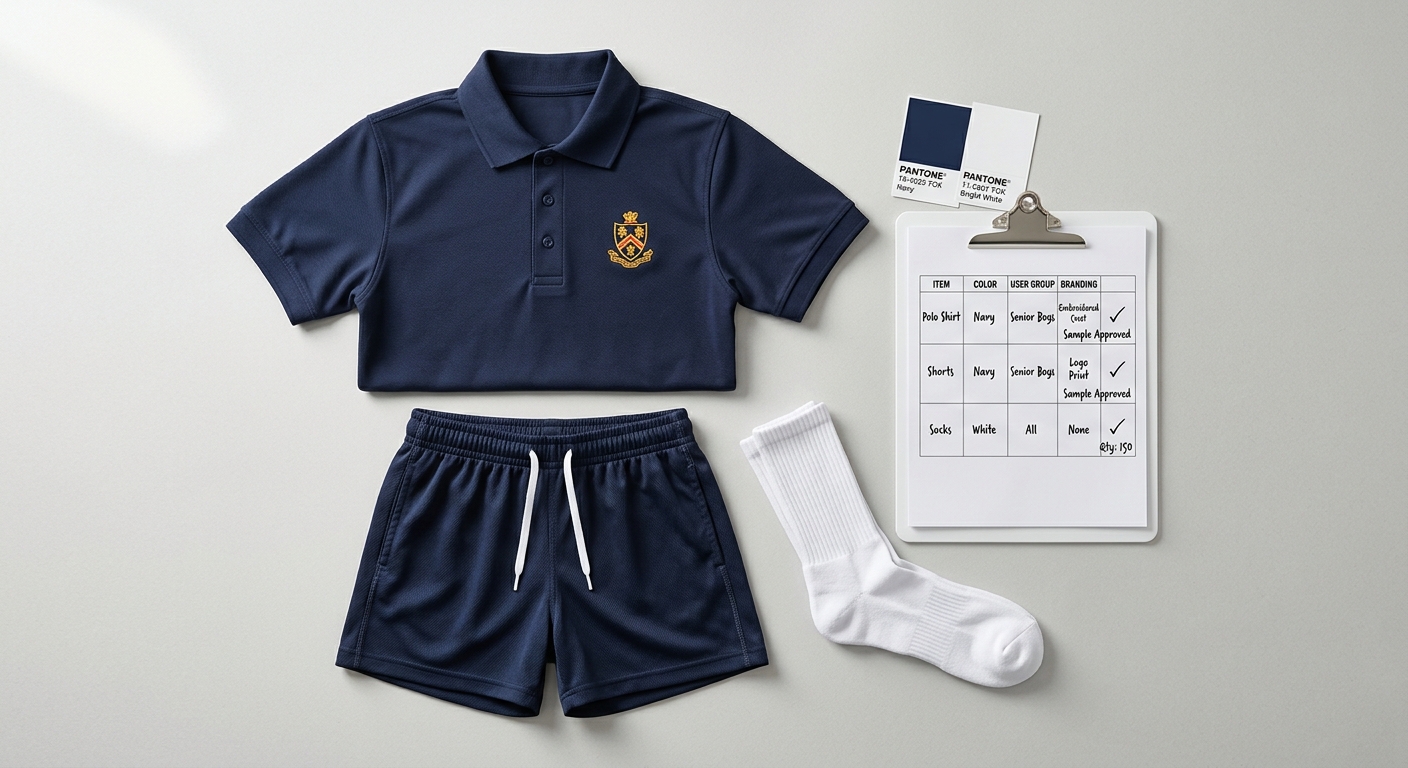
Schools planning a school PE kit program often approach suppliers with incomplete information, which delays sampling and increases revision cycles.
A structured list solves three problems:
- Aligns internal stakeholders before external discussions begin
- Reduces back-and-forth by surfacing key decisions early
- Gives suppliers enough context to recommend suitable options from their current catalog
Who benefits:
| Stakeholder | Primary Need |
|---|---|
| School procurement staff | Consolidated view of all required items |
| PE department heads | Confirmation that activity needs are covered |
| Distributors / resellers | Clear brief to pass to the manufacturer |
| Etonkidd account team | Structured input to match against available products |
A product list is not a final purchase order. It is a working document that organizes what you know, flags what you are uncertain about, and creates a shared starting point for discussion.
Step 1 — Define Your Activity Categories First
Before listing individual products, group requirements by activity type or use context. This prevents gaps and avoids ordering items that overlap in function.
Common Activity-Based Groupings for School Sportswear
Outdoor field sports (football, rugby, athletics):
- Typically require outerwear layers, shorts, and socks
- Consider wet-weather and dry-weather use separately
Indoor sports (gymnastics, basketball, badminton):
- Usually covered by a core school sports uniform set
- Layering needs differ from outdoor kits
Cross-school or inter-school events:
- May require a distinct color or branding treatment
- Often a separate SKU from daily PE wear
Year-round physical education (general PE):
- The most common category in school PE uniform planning
- Typically the highest-volume item in any order
Grouping Table
| Activity Context | Typical Item Types | Notes |
|---|---|---|
| General PE (indoor) | Top, shorts or leggings | Core daily-use items |
| Outdoor sports | Top, shorts, outerwear | Weather context matters |
| Team / competitive sports | Matching set, optional accessories | Branding often required |
| Swimming / aquatics | Refer to current Etonkidd catalog | Separate category |
| Dance / gymnastics | Refer to current Etonkidd catalog | Movement range is a key discussion point |
Note: Do not assign fixed quantities at this stage. Volume decisions belong in a later commercial discussion.
Step 2 — Record Key Details for Each Product
Once categories are set, document what you know — and what you do not — for each item.
What to Record Per Item
Required fields:
- Item name / description: e.g., “short-sleeve training top”
- Intended use: which activity group does it serve
- User group: age range, year group, or gender split if applicable
- Color preferences: school colors, existing uniform palette
- Branding requirements: logo placement, embroidery vs. print (if known)
- Approximate size range: e.g., ages 5–16, or adult XS–XL for staff
Optional fields (record if known):
- Preferred silhouette or fit style
- Any existing samples or reference products
- Whether this item needs to coordinate with a current uniform range
- Seasonal priority (summer term launch vs. full-year rollout)
Product Detail Template
| Field | Example Entry | Status |
|---|---|---|
| Item | Short-sleeve polo top | Confirmed |
| Activity group | General PE | Confirmed |
| User group | Years 7–11, mixed | Confirmed |
| Color | Navy / white trim | Confirmed |
| Branding | School crest, left chest | Confirmed |
| Size range | 28″–38″ chest | Estimated |
| Coordination need | Match existing navy blazer | Yes |
| Reference sample | Current supplier’s top | Available |
Important: Do not specify fabric compositions, GSM values, or performance certifications unless you have confirmed these requirements internally. These are discussion points, not list entries.
Step 3 — Coordinate with the Wider School Uniform Range
A school sports kit that clashes with the main uniform undermines the school’s visual identity. Coordination should be addressed during list preparation, not after sampling.
Coordination Checklist
- Color matching: Identify the exact colors used in the main uniform (Pantone, RAL, or a physical swatch is ideal)
- Logo consistency: Confirm whether the PE kit uses the same crest/logo as the uniform or a sport-specific version
- Fabric tone alignment: Dark navy in outerwear should read consistently across PE and academic uniform items
- Supplier alignment: If the main uniform is also supplied by Etonkidd, note this — it simplifies color and branding coordination
Why This Step Is Often Skipped (and Why It Shouldn’t Be)
Schools frequently treat school sportswear and academic uniform as separate procurement exercises. This creates:
- Color inconsistencies across year groups
- Duplicate branding artwork files with minor variations
- Parent confusion when purchasing replacement items
Documenting coordination requirements upfront reduces these issues significantly.
Step 4 — How to Submit Your Requirements to Etonkidd
Etonkidd works with schools and distributors at inquiry stage. The goal of your first submission is to open a structured conversation, not to place an order.
What to Include in Your Initial Inquiry
Minimum useful submission:
- School name and location (country / region)
- Whether you are a school direct or working through a distributor
- A categorized product list (as built in Steps 1–3)
- Estimated launch timeline (term or quarter)
- Any reference images, existing samples, or branding files
What to avoid at this stage:
- Fixed quantity commitments before sampling
- Unverified fabric or performance specifications
- Assumptions about standard product configurations — Etonkidd’s available range is best confirmed against their current product catalog
Submission Channels
Visit www.etonkidd.com to access the current product catalog and contact options. The inquiry form or direct contact route allows you to attach your product list and any reference materials.
Etonkidd serves both direct school accounts and distributor partners. Indicate your role clearly in the initial message to ensure the right team responds.
Real-World Use Cases
Case 1 — Primary school, full PE kit refresh
A primary school replacing its entire school PE uniform range across ages 5–11 uses the category grouping method to separate general PE items from swimming kit. They submit color swatches from their existing uniform and a list of 6 confirmed item types, with quantities marked as “TBC pending supplier discussion.”
Case 2 — Distributor managing multiple school accounts
A regional distributor handling school sports uniform orders for three secondary schools prepares a consolidated list with school-specific color and branding columns. They submit one inquiry to Etonkidd with a clear per-school breakdown, reducing the number of separate communications.
Case 3 — New international school, no existing uniform
A new school with no prior uniform history submits a brief listing activity categories, a target age range, and preferred color palette. They request to see relevant items from Etonkidd’s current catalog before finalizing their list — an appropriate first step when preferences are not yet fixed.
FAQ
What information should a school consider when preparing a PE kit list?
Activity categories, user age groups, color preferences, branding requirements, and coordination with the existing uniform.
How can buyers group PE kit products by activity or use?
Separate items into general PE, outdoor sports, competitive/team sports, and specialist categories such as aquatics.
What details should be recorded for each product in a PE kit?
Item name, intended use, user group, color, branding needs, and approximate size range.
How can a PE kit coordinate with a school’s wider uniform range?
Document existing uniform colors, logo files, and supplier details before starting the PE kit list.
What information can buyers share when discussing PE kit options?
A categorized product list, reference samples or images, branding files, and an estimated launch timeline.
Should quantities be included in the initial product list?
No. Quantities are confirmed after sampling and commercial discussion, not during list preparation.
Can distributors submit a combined list for multiple schools?
Yes. A per-school breakdown within one submission is a practical approach for multi-account distributors.
Where can I confirm what products Etonkidd currently offers?
Check the current catalog at www.etonkidd.com before finalizing your list.
Conclusion
A structured PE kit product list is the most effective tool for opening a productive supplier discussion. By grouping items by activity, recording confirmed details separately from assumptions, and aligning with the school’s broader uniform identity, buyers provide suppliers with the context needed to respond accurately.
Key actions:
- Build your list by activity category, not by item type alone
- Record only confirmed details; flag uncertainties explicitly
- Coordinate color and branding with the main uniform before submission
- Submit to Etonkidd via www.etonkidd.com with a categorized list and any available reference materials
- Avoid specifying quantities, fabric specs, or product configurations until after initial discussion
A clear brief shortens the path from inquiry to sample — for both schools planning their first school sports kit and distributors managing multiple accounts.
References and Further Reading
- Etonkidd product catalog: www.etonkidd.com
- UK Department for Education: School Uniform Guidance, updated 2021 — outlines cost and coordination principles applicable to PE kit procurement
- NASPE (National Association for Sport and Physical Education): guidelines on age-appropriate sportswear for school programs
- ISO 3635: Size designation of clothes — standard reference for school garment sizing documentation