How to Organize Formal, Daily and PE Uniform Categories
Subitle: Separate uniform needs by use to create a clearer product plan for a school.
Executive Summary
Organizing school uniform needs by use category—formal uniforms, daily campus wear, and PE kit—helps schools communicate requirements clearly to suppliers and avoid specification gaps. Each category serves distinct functional and institutional purposes and may involve different fabrics, construction standards, and procurement timelines.
Why Category Separation Matters in Uniform Planning
Schools frequently approach suppliers with mixed or incomplete briefs. Separating requirements by use case resolves this.
Core problems caused by undifferentiated briefs:
- Fabric specs appropriate for formal occasions are applied to high-wear daily items
- PE garments are quoted under the same durability tier as dress uniforms
- Budget allocation becomes inaccurate when categories are bundled
What category separation achieves:
- Cleaner RFQ documents with use-specific technical requirements
- More accurate per-unit cost modeling by category
- Reduced revision cycles between school and supplier
Practical trigger points for category review:
- School is launching a new uniform program from scratch
- Existing uniform has complaints about durability or comfort
- School is expanding grade levels or adding co-curricular programs
A structured category framework does not require every school to adopt all three tiers. Some schools operate with two categories; others maintain four or more sub-lines. The framework is a planning tool, not a mandate.
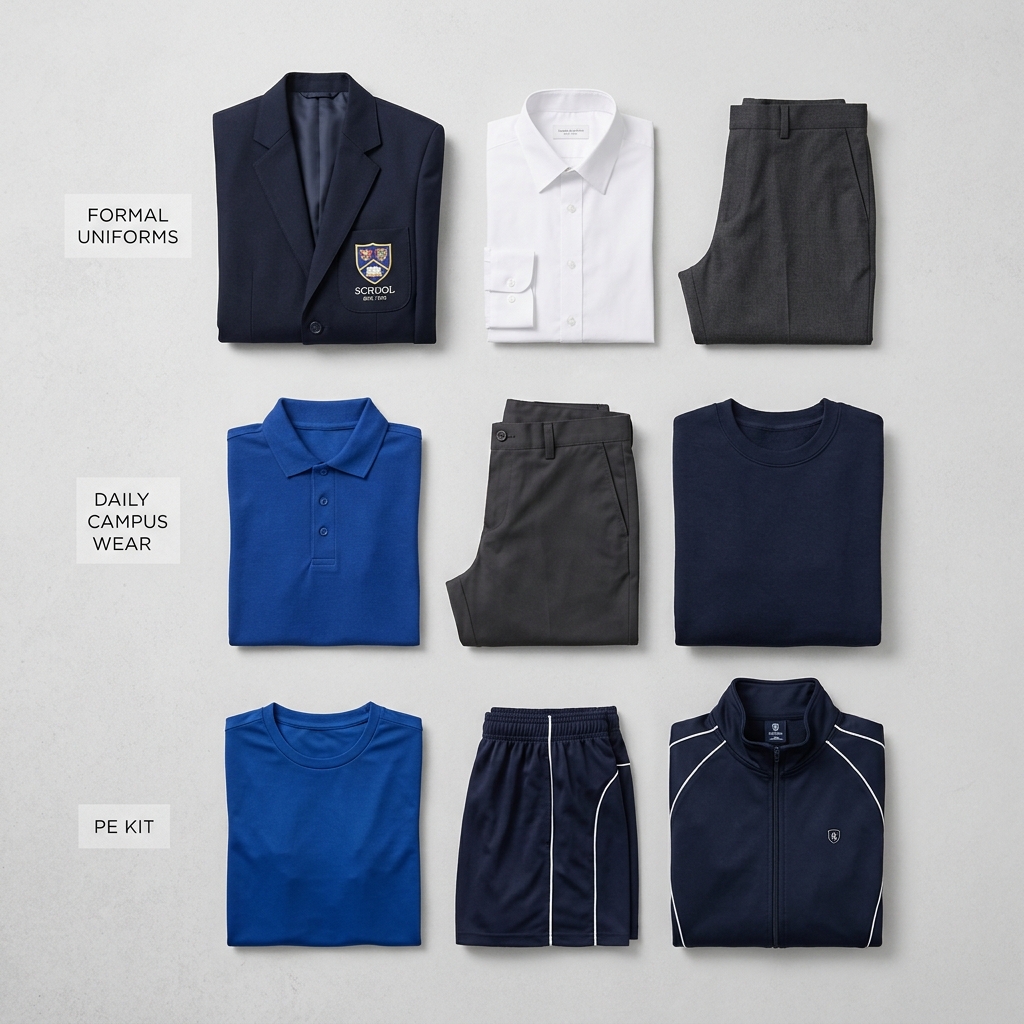
Formal Uniforms: Definition, Products, and Specifications
What Defines a Formal School Uniform
Formal uniforms are worn during scheduled institutional events: assemblies, graduation ceremonies, external competitions, and official school photography days. They prioritize appearance consistency and institutional identity over daily wear durability.
Key characteristics:
- Structured silhouette with tailored or semi-tailored cut
- Higher-weight woven fabrics (wool blends, polyester-viscose, twill)
- School branding typically achieved through embroidery or woven badges
- Lower wash frequency → longer per-garment lifespan
Typical Product Categories for Formal Uniforms
| Product | Common Fabric | Typical Weight |
|---|---|---|
| Blazer / Suit Jacket | Polyester-wool blend | 220–280 gsm |
| Dress Trousers / Skirt | Polyester-viscose twill | 180–220 gsm |
| Formal Dress Shirt | Cotton-polyester poplin | 110–130 gsm |
| School Tie / Bow Tie | Woven polyester | — |
| Formal Dress (girls) | Polyester-cotton blend | 140–160 gsm |
Specification Considerations
- Colorfastness: ISO 105-C06 wash fastness rating of 4 or above recommended for dyed outerwear
- Dimensional stability: Shrinkage under 3% after five wash cycles for woven trousers and skirts
- Embroidery placement: Chest badge positioning should be standardized across genders for visual uniformity in group settings
Daily Campus Wear: Definition, Products, and Planning Considerations
What Separates Daily Campus Wear from Formal Uniforms
Daily campus wear covers the garments students wear across standard instructional hours—five days per week, across the full academic year. Wash frequency is significantly higher (3–5× per week versus 1–2× for formal items), which shifts the specification priority toward durability and comfort.
Functional priorities for daily school uniform items:
- Abrasion resistance at stress points (knees, elbows, collar)
- Colorfastness under frequent machine washing (40°C–60°C cycles)
- Ease of movement for classroom and corridor activity
- Accessible price point to allow families to own 2–3 sets
Typical Product Categories for Daily Campus Wear
| Product | Common Fabric | Functional Feature |
|---|---|---|
| Polo Shirt | 100% cotton or CVC piqué | Breathability, easy care |
| School Trousers (casual) | Polyester-cotton chino | Durability, shape retention |
| Skirt / Pinafore | Polyester-viscose | Pleat retention after washing |
| Sweatshirt / Jumper | 80/20 cotton-polyester fleece | Warmth, pill resistance |
| School Shorts | Polyester-cotton twill | Abrasion resistance |
Planning Factors Schools Should Evaluate
- Climate zone: Tropical and subtropical climates require lighter-weight, moisture-wicking daily fabrics (120–150 gsm polos vs. 170–180 gsm for temperate zones)
- Age group: Younger students (ages 5–10) benefit from reinforced seams and elasticated waistbands
- Gender-inclusive options: Many schools now request unisex trouser and polo options alongside traditional gender-specific cuts
- Sizing range: A complete daily wear program typically requires 20–28 size points to cover primary through secondary grades
PE Kit and Sports Uniform: Fitting Into the Wider Plan
How PE Products Differ Technically
PE kit operates under entirely different performance requirements compared to both formal and daily campus wear categories. Garments are subject to high-intensity movement, perspiration, and outdoor exposure.
Technical differentiators:
- Fabric construction: knit-based (jersey, interlock, mesh) rather than woven
- Moisture management: moisture-wicking polyester or polyester-spandex blends
- Stretch requirement: minimum 20–30% four-way stretch for active movement
- UV resistance: UPF 30+ for outdoor PE programs in high-UV regions
Typical PE Kit Product Categories
| Product | Fabric | Performance Spec |
|---|---|---|
| PE T-Shirt | 100% polyester jersey | Moisture-wicking, UPF 30+ |
| PE Shorts | Polyester-spandex | 4-way stretch, quick-dry |
| Track Jacket | Polyester tricot | Wind resistance, zip closure |
| Track Pants | Polyester-cotton or full poly | Tapered fit, elastic cuff |
| Sports Socks | Cotton-polyester-elastane | Arch support, blister resistance |
| Training Vest | Mesh polyester | Maximum breathability |
Integrating PE Kit Into the Broader Uniform Plan
- Schools may treat PE kit as a standalone sub-category with a separate budget line
- Some schools require PE kit to share color palette with formal/daily wear for visual brand consistency
- Schools with competitive sports programs often develop a separate school sports uniform layer (match kits, team tracksuits) beyond standard PE kit
- Sublimation printing is the dominant decoration method for PE garments due to durability under repeated high-temperature washing
Information Schools Should Prepare Before Engaging a Supplier
Suppliers can produce more accurate proposals when schools provide structured category briefs. Disorganized briefs extend the quoting process by 2–4 weeks on average.
Minimum Information Per Category
| Data Point | Formal | Daily | PE |
|---|---|---|---|
| Gender split (boys/girls/unisex) | ✓ | ✓ | ✓ |
| Grade range covered | ✓ | ✓ | ✓ |
| Estimated annual quantity per SKU | ✓ | ✓ | ✓ |
| Brand colors (Pantone/RAL reference) | ✓ | ✓ | ✓ |
| Logo/badge artwork files | ✓ | ✓ | ✓ |
| Fabric preference or restriction | ✓ | ✓ | ✓ |
| Wash care requirement | — | ✓ | ✓ |
| Performance standard (UPF, stretch) | — | — | ✓ |
Additional Context That Accelerates Supplier Response
- School’s geographic location (climate informs fabric weight)
- Existing supplier relationship and reason for change
- Target delivery window and academic calendar constraints
- Whether a uniform policy document exists
Real-World Application Scenarios
Scenario 1 — New International School (K–12 Launch)
A school opening its first campus needs all three categories simultaneously. Recommended approach: develop formal and daily wear specifications first (longer lead time for woven items), then finalize PE kit in a second phase. Total SKU count typically ranges 18–35 across all categories.
Scenario 2 — Existing School Refreshing Daily Wear Only
A school satisfied with its formal blazer program but receiving durability complaints about polo shirts. Category separation allows the school to issue an RFQ exclusively for daily campus wear without disrupting the formal uniform contract.
Scenario 3 — Sports-Focused School Adding Match Kits
A school with an established PE kit program expanding into competitive sports. The new school sports uniform layer (sublimation match jerseys, team tracksuits) is added as a fourth category without restructuring the existing three-tier plan.
FAQ
What is the difference between formal uniform and daily campus wear?
Formal uniforms are event-specific; daily campus wear is worn every instructional day and requires higher wash durability.
What product categories may be considered for formal uniforms?
Blazers, tailored trousers, dress shirts, formal skirts, ties, and embroidered badges.
What should schools consider when planning daily campus wear?
Wash frequency, climate zone, age group, sizing range, and per-family cost of owning multiple sets.
How can PE products fit into a wider school uniform plan?
As a distinct technical category with separate fabric specs, decoration methods, and potentially a separate budget line.
What information helps a supplier understand the product categories a school wants?
Gender split, grade range, estimated quantities, brand colors, logo files, and fabric preferences per category.
Does every school need all three categories?
No. Some schools operate with two categories; others add sub-lines for competitive sports. Category structure depends on the school’s program.
Why does category separation reduce procurement errors?
It prevents mismatched specifications—e.g., applying formal fabric standards to high-frequency wash items—and produces more accurate cost modeling.
What is the typical lead time difference between woven and performance fabrics?
Woven formal and daily wear: 60–90 days. Performance PE knits: 45–75 days, depending on decoration method.
Conclusion
Separating school uniform needs into formal uniforms, daily campus wear, and PE kit provides a practical framework for clearer supplier communication, more accurate budgeting, and better product-to-use alignment. Schools are not required to adopt all three categories—the value lies in defining whichever categories apply and documenting them with use-specific technical requirements before engaging suppliers.
Recommended next steps:
- Map current garments against the three category definitions
- Identify gaps or misclassified items in the existing program
- Prepare a per-category brief using the data point checklist above
- Submit structured RFQs by category rather than as a single bundled request
References and Standards
- ISO 105-C06: Textiles — Tests for colour fastness to domestic and commercial laundering
- OEKO-TEX Standard 100: Chemical safety benchmark for school-age garment production
- ASTM D3776: Standard test methods for mass per unit area (weight) of fabric
- AS/NZS 4399: Sun protective clothing — Evaluation and classification (UPF rating standard)
- BS EN ISO 13934-1: Tensile properties of fabrics — determination of maximum force and elongation