
School Uniform Quality Checks: How to Review Fabric, Samples and Bulk Production
A practical checklist for assessing fabric, approving samples and aligning bulk production with your requirements.
Executive Summary
School uniform quality checks cover two distinct phases: sample approval and bulk production inspection. Buyers must evaluate fabric performance, construction accuracy, and dimensional consistency at each stage. Skipping either phase increases the risk of costly rejections and delivery delays.
Why Quality Checks Differ Between Samples and Bulk Production
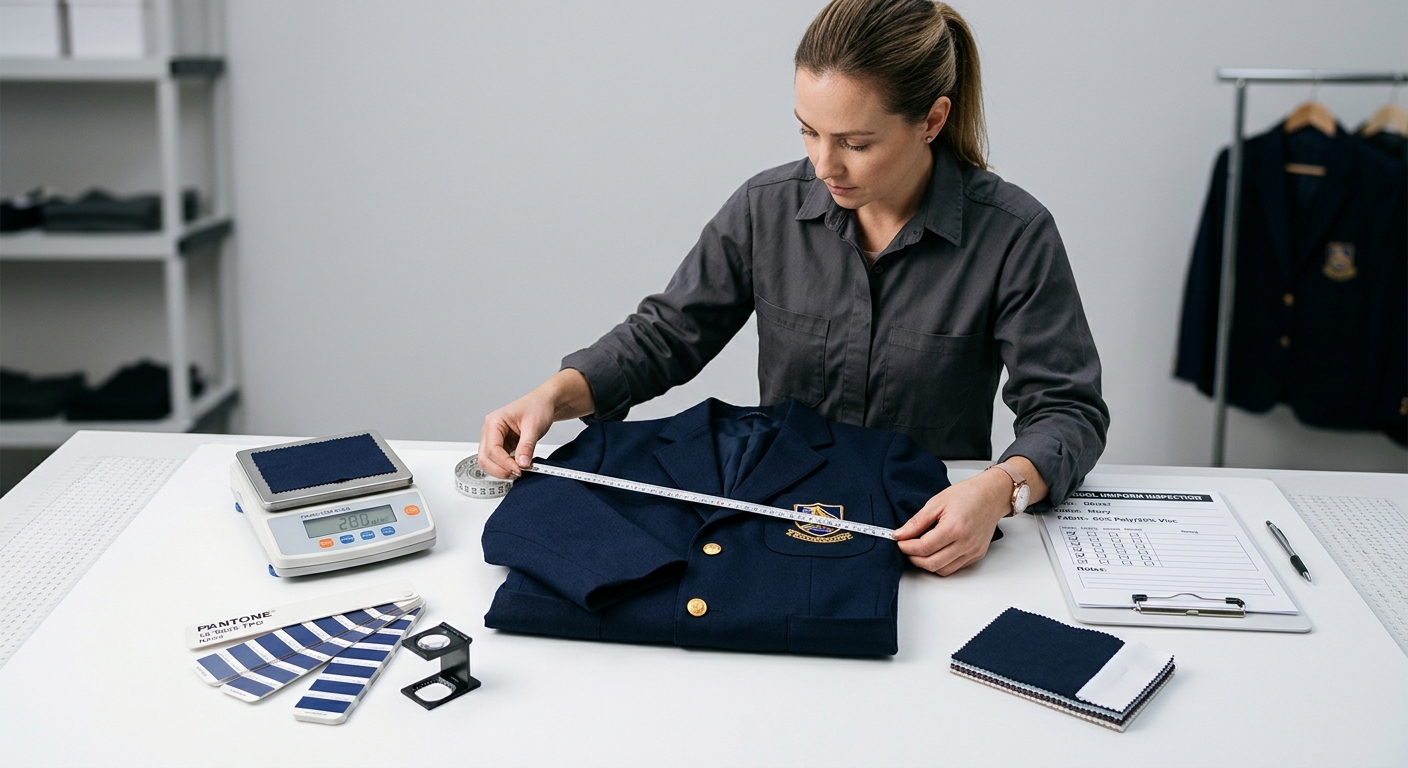
Sample review and bulk inspection serve different purposes and require different evaluation frameworks.
Sample stage confirms whether the manufacturer understands your specifications.
Bulk stage confirms whether production was executed consistently at scale.
Treating both stages identically is a common buyer error. A sample can be hand-finished to pass visual inspection while bulk units are machine-produced under time pressure, introducing defects that samples never revealed.
| Stage | Primary Goal | Key Risk |
|---|---|---|
| Sample Review | Spec alignment | Misinterpretation of requirements |
| Bulk Inspection | Consistency at scale | Production shortcuts, material substitution |
| Pre-shipment Check | Final conformity | Mixed sizes, incorrect labeling |
Core principle: Approve nothing in bulk that was not explicitly confirmed at sample stage. Any unresolved sample issue will multiply across thousands of units.
How to Assess School Uniform Fabric Quality
Fabric is the most substituted component in uniform manufacturing. Suppliers under cost pressure may switch fabric weight, fiber blend, or finish without disclosure.
Fiber Composition Verification
- Request mill certificates or fabric test reports for every fabric used.
- Verify fiber content matches the approved spec (e.g., 65% polyester / 35% cotton).
- Tolerance: ±3% fiber variance is industry-standard; beyond that, request re-testing.
- Common substitution risk: replacing cotton content with cheaper viscose.
Fabric Weight and Construction
- Measure GSM (grams per square meter) using a fabric scale or send to a third-party lab.
- Typical school uniform GSM ranges:
| Garment Type | Recommended GSM Range | Notes |
|---|---|---|
| Polo shirt | 180–220 gsm | Below 180 gsm pills quickly |
| Trousers / Skirts | 220–280 gsm | Heavier for winter programs |
| Blazer outer shell | 280–320 gsm | Requires interlining check |
| PE shorts | 140–170 gsm | Stretch and recovery critical |
- Check weave tightness: hold fabric to light. Loose weaves indicate lower yarn count.
Colorfastness and Shrinkage
- Require ISO 105-C06 wash test results (colorfastness to washing).
- Minimum acceptable rating: Grade 4 for color change, Grade 3–4 for staining.
- Shrinkage tolerance: ≤3% after 3 wash cycles at 40°C.
- Dark colors (navy, black, bottle green) are highest risk for fading — always test separately.
Pilling and Abrasion Resistance
- Use Martindale abrasion test (ISO 12947): minimum 20,000 cycles for school-use garments.
- Pilling rating (ISO 12945): Grade 3 minimum for acceptable appearance retention.
What to Check on a School Uniform Sample
A school uniform sample approval is a technical review, not a fashion fitting. Every element must be measured and documented.
Construction and Stitching
- Stitch density: 10–12 stitches per cm for seam integrity on woven fabrics.
- Seam allowance: Minimum 1.2 cm on stress points (armhole, crotch, shoulder).
- Bartacks: Required at pocket corners, belt loops, and fly base.
- Check for skipped stitches, puckering, and uneven tension throughout.
- Inspect overlocked seams: edges should be fully encased with no raw threads visible.
Measurements and Fit
- Compare every size point against your approved tech pack or size chart.
- Acceptable measurement tolerance: ±1 cm on body measurements, ±0.5 cm on critical points (collar, waistband).
- Check ease allowance — school uniforms require functional ease for active movement.
- Verify that size labels match the actual measured dimensions.
Trimmings and Hardware
| Component | Check Points |
|---|---|
| Buttons | Attachment strength (pull test: >50N), shank type, color consistency |
| Zippers | Smooth operation, slider lock function, tape color match |
| Embroidery / Logos | Thread color vs. Pantone reference, density, edge definition |
| Labels | Care instruction accuracy, fiber content compliance, country of origin |
| Elastic | Recovery after 50% stretch, width consistency, attachment method |
Color and Appearance
- Compare sample color against approved Pantone or physical color standard under D65 lighting.
- Check color consistency across all components (body, collar, cuffs must match).
- Inspect for surface defects: oil stains, snags, uneven dyeing, fabric holes.
How to Confirm Bulk Uniforms Match the Approved Sample
Bulk production inspection for school uniforms follows AQL (Acceptable Quality Level) sampling protocols.
AQL Sampling Framework
- AQL 2.5 is standard for major defects (wrong size, broken zipper, incorrect logo).
- AQL 4.0 is acceptable for minor defects (loose thread, slight shade variation).
- Sample size is determined by production lot size per ISO 2859-1 / ANSI/ASQ Z1.4.
Recommended inspection approach:
- Conduct inline inspection at 30–50% production completion.
- Conduct final random inspection before packing.
- Never inspect only the top cartons — pull units from multiple carton layers.
Critical Bulk Inspection Points
- Workmanship: Apply the same construction checklist used for sample approval.
- Measurement audit: Re-measure 10% of units per size; flag if >5% of units fall outside tolerance.
- Color consistency: Check for shade variation between production batches (dye lot variation is common in large orders).
- Packing verification: Confirm size ratios, poly bag labeling, and carton marking match purchase order.
- Quantity count: Conduct physical count on at least 10% of cartons.
Common Bulk Defects by Category
| Defect Type | Frequency | Detection Method |
|---|---|---|
| Measurement deviation | High | Tape measure audit |
| Shade variation between batches | Medium-High | Visual under D65 light |
| Incorrect or missing labels | Medium | 100% label check on sample |
| Stitching failures at stress points | Medium | Pull test on seams |
| Logo misplacement | Low-Medium | Position template overlay |
Should Every Uniform Program Use the Same Quality Standards?
No. Quality standards must be calibrated to program context.
Factors that determine appropriate QC level:
- Order volume: High-volume programs (>5,000 units) justify third-party inspection costs.
- Garment complexity: Blazers with lining require more inspection points than basic polos.
- End user age group: Primary school garments require stricter chemical safety compliance (REACH, Oeko-Tex Standard 100).
- Climate requirements: Tropical programs prioritize moisture management; cold-climate programs prioritize thermal retention.
- Brand or institutional standards: Some schools require specific accreditation (e.g., ISO 9001-certified supplier).
Minimum non-negotiable standards regardless of program size:
- Fiber content accuracy
- Colorfastness Grade 4
- Correct care labeling
- No restricted substances (formaldehyde, azo dyes)
Real-World Application Scenarios
Scenario 1 — Primary School Polo Program (2,000 units)
Buyer requires Oeko-Tex Standard 100 certification for all fabrics. Sample check focuses on label accuracy and colorfastness. Bulk inspection uses AQL 2.5 with inline check at 40% production.
Scenario 2 — Secondary School Full Uniform Set (8,000 units, 6 garments)
Buyer appoints third-party QC agency. Separate fabric tests ordered for blazer shell and trouser fabric. Pre-shipment inspection covers all six garment types with size audit across all sizes.
Scenario 3 — International School Blazer Reorder (1,200 units)
Buyer holds physical color standard from original order. New production batch compared against original standard under D65 lighting. Shade tolerance set at ΔE ≤1.5.
FAQ: School Uniform Quality Checks
What should buyers check when reviewing a school uniform sample?
Construction, measurements, trimmings, color accuracy, and label compliance.
How can buyers assess school uniform fabric quality?
Request GSM data, fiber test reports, wash-fastness results, and pilling ratings.
How do you confirm bulk uniforms match the approved sample?
Use AQL sampling, inline inspection, measurement audits, and shade comparison.
What details should be included in a uniform quality checklist?
Fabric specs, stitch density, measurements, hardware function, labeling, and packing.
Should every uniform program use the same quality standards?
No — calibrate standards to order volume, garment type, and end-user requirements.
What is an acceptable shrinkage rate for school uniforms?
≤3% after three wash cycles at 40°C is the industry benchmark.
When should a third-party inspection be used?
For orders exceeding 5,000 units or multi-garment programs with complex specifications.
What chemical safety standards apply to school uniforms?
REACH regulations and Oeko-Tex Standard 100 are the primary compliance frameworks.
Conclusion
Effective school uniform quality control requires structured evaluation at two independent stages. Sample approval establishes the technical baseline; bulk inspection confirms that baseline was maintained at production scale.
Key actions for buyers:
- Document every approved specification in a written tech pack before sampling begins.
- Never approve bulk production based on visual sample review alone — measure and test.
- Apply AQL 2.5 as the default standard for major defects in bulk inspection.
- Require fabric test reports, not just supplier declarations.
Buyers who implement both stages systematically reduce rejection rates, minimize reorder costs, and maintain consistent uniform standards across multi-year programs.
References and Standards
- ISO 105-C06: Colorfastness to domestic and commercial laundering
- ISO 12947: Martindale abrasion and pilling test method
- ISO 12945: Pilling resistance of fabrics
- ISO 2859-1 / ANSI/ASQ Z1.4: Sampling procedures for inspection by attributes (AQL framework)
- Oeko-Tex Standard 100: Testing for harmful substances in textiles
- REACH Regulation (EC) No 1907/2006: Restriction of hazardous chemical substances
- ASTM D3776: Standard test method for mass per unit area (GSM) of fabric


