The Complete Buyer’s Guide to K12 School Uniforms: Quality Standards, Vendor Red Flags & Contract Traps
Subtitle: A reference for educational procurement decision-makers covering quality benchmarks, supplier evaluation, and contract negotiation pitfalls.
Executive Summary: K12 uniform procurement failures stem from three root causes: substandard fabric specifications, unvetted vendor practices, and exploitative contract clauses. This guide provides measurable benchmarks and actionable red flags to protect institutional budgets and ensure multi-year uniform durability.
Section 1: Fabric Composition Standards and Durability Benchmarks
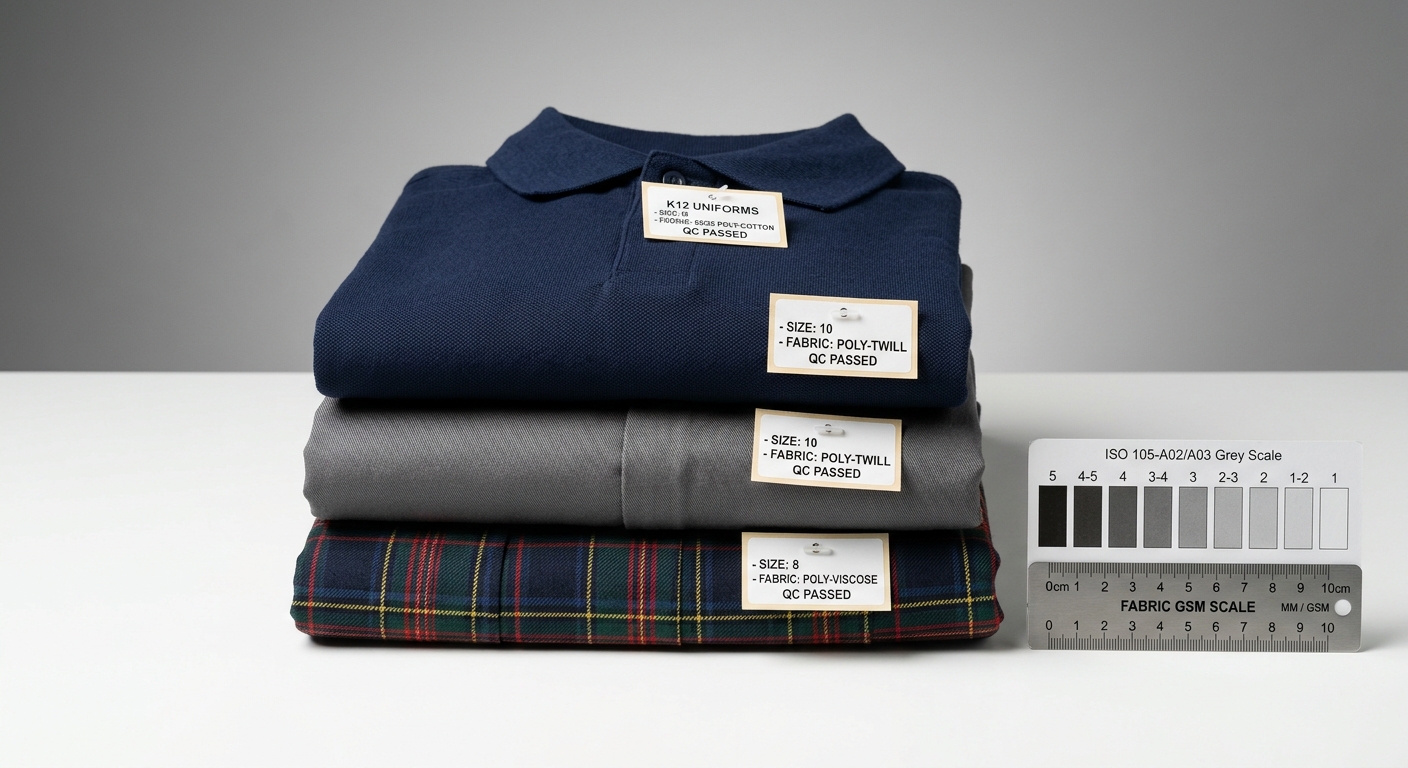
How Fabric Composition Percentage Affects K12 Uniform Durability
Fabric composition is the single most predictive variable in K12 uniform lifecycle performance.
Industry-accepted composition thresholds:
| Fabric Type | Recommended Blend | Wash Cycles Before Degradation | Pilling Resistance (ASTM D3512) |
|---|---|---|---|
| Polyester/Cotton | 65% Poly / 35% Cotton | 80–100 cycles | Grade 3–4 |
| 100% Cotton | Pure cotton | 40–60 cycles | Grade 2 |
| Poly/Viscose | 55% Poly / 45% Viscose | 50–70 cycles | Grade 2–3 |
| Performance Knit | 80% Poly / 20% Spandex | 90–120 cycles | Grade 4 |
- 65/35 poly-cotton is the institutional standard for K12 school uniforms due to balanced breathability and abrasion resistance.
- Fabrics below 180 GSM (grams per square meter) fail accelerated wear tests within one academic year under daily use conditions.
- 100% cotton uniforms carry a 40% higher replacement rate in bulk school uniform buying scenarios versus blended fabrics.
- Require suppliers to provide ISO 13934-1 tensile strength test certificates as a baseline in any school uniform quality standards checklist.
Thread Count and Seam Integrity
- Minimum seam strength: ≥ 196 N per ISO 13935-2 for stress-point seams (underarms, crotch, shoulder).
- Stitch density: 8–12 stitches per centimeter for high-movement zones.
- Bartack reinforcement is mandatory at pocket corners and waistband stress points.
Section 2: Colorfastness Ratings and Lifecycle Cost Implications
How Colorfastness Ratings Impact Long-Term K12 Uniform Lifecycle Costs
Colorfastness failure is a primary driver of premature uniform replacement, directly inflating per-student annual costs.
Colorfastness rating scale (ISO 105 series):
| Test Type | Minimum Acceptable Grade | Failure Grade | Cost Impact at Grade Failure |
|---|---|---|---|
| Washing (ISO 105-C06) | Grade 4 | Below Grade 3 | +35% replacement cost/year |
| Rubbing – Dry (ISO 105-X12) | Grade 4 | Below Grade 3 | Visible fading within 20 washes |
| Rubbing – Wet (ISO 105-X12) | Grade 3 | Below Grade 2.5 | Dye transfer to skin/other garments |
| Light Fastness (ISO 105-B02) | Grade 5 | Below Grade 4 | Outdoor PE uniform fading in 6 months |
| Perspiration (ISO 105-E04) | Grade 3–4 | Below Grade 3 | Student complaints, parent escalations |
- A one-grade drop in washing colorfastness correlates with a 22–35% increase in annual uniform replacement budget per ISSA procurement benchmarks.
- Reactive dyes on cotton substrates consistently outperform direct dyes by 1.5–2 grade points under ISO 105-C06 washing tests.
- Demand pre-production dye lot samples tested to ISO 105 before approving bulk production runs.
- Schools procuring 500+ units annually should mandate third-party colorfastness verification through accredited labs (SGS, Intertek, Bureau Veritas).
Section 3: Vendor Audit Metrics and Delivery Failure Risk Prediction
Which Vendor Audit Metrics Predict K12 Uniform Delivery Failure Risk
When evaluating school uniform vendors, quantitative audit scores predict failure more reliably than references or marketing claims.
Critical vendor audit scorecard:
| Audit Metric | Green (Low Risk) | Amber (Monitor) | Red (Reject) |
|---|---|---|---|
| On-Time Delivery Rate (trailing 12 months) | ≥ 95% | 85–94% | < 85% |
| AQL 2.5 Pass Rate | ≥ 98% | 92–97% | < 92% |
| Financial Stability (Dun & Bradstreet score) | 70–100 | 50–69 | < 50 |
| Sub-contractor Disclosure | Full disclosure | Partial | None |
| ISO 9001 / WRAP Certification | Current | Expired < 1 year | None |
| Sample-to-Bulk Consistency Rate | ≥ 97% | 90–96% | < 90% |
K12 uniform supplier red flags to eliminate vendors immediately:
- Refusal to disclose sub-manufacturing facilities.
- Sample garments produced in a different factory than bulk production.
- No documented AQL (Acceptable Quality Level) inspection protocol.
- Price quotes 30%+ below market average — a reliable indicator of material substitution risk.
- Inability to provide country-of-origin certificates or fabric mill traceability documentation.
Vendor audit process for uniform RFP for schools:
- Issue a formal RFP requiring ISO certifications, factory audit reports, and financial references.
- Conduct virtual or on-site factory audits for any vendor supplying 1,000+ units.
- Require pre-shipment third-party inspection (AQL 2.5) as a non-negotiable contract term.
Section 4: Contract Clauses That Create Hidden Liability
What Contract Clauses Create Hidden Liability in School Uniform Procurement
School uniform contract negotiation tips are most critical at the clause level, where ambiguous language shifts financial risk to the buyer.
High-risk contract clauses to identify and renegotiate:
- “Reasonable substitution” clauses: Allow vendors to swap specified fabric compositions without prior approval. Demand explicit material change notification requirements with buyer veto rights.
- Force majeure over-breadth: Clauses listing “supply chain disruption” as a catch-all void delivery penalty enforcement. Require specific, enumerated qualifying events only.
- Acceptance-on-delivery terms: Transfer quality liability to the buyer upon receipt before inspection is complete. Negotiate a 14–21 day post-delivery inspection window.
- Automatic renewal provisions: Lock institutions into multi-year contracts without performance reviews. Insert annual performance benchmarks with exit triggers.
- IP and logo ownership ambiguity: Vendor retains design files and embroidery digitizations. Ensure explicit IP transfer clauses for all school-branded assets.
- Liquidated damages caps: Vendors cap penalty exposure at 5–10% of contract value, insufficient to cover replacement costs. Negotiate caps at 25–30% minimum.
Educational procurement pitfalls in payment structures:
- Avoid >40% upfront deposits without a performance bond or letter of credit.
- Require milestone-based payment: 30% deposit / 40% pre-shipment inspection / 30% net-30 post-delivery.
- Insert currency lock clauses for international suppliers to prevent invoice inflation.
Section 5: MOQ Structure and Cost-Efficiency at Scale
How MOQ Structure Affects K12 Procurement Cost-Efficiency at Scale
MOQ (Minimum Order Quantity) architecture directly determines per-unit economics in bulk school uniform buying programs.
MOQ cost-efficiency thresholds by school size:
| Institution Size (Students) | Optimal MOQ per SKU | Expected Unit Cost Reduction | Recommended Strategy |
|---|---|---|---|
| < 200 students | 50–100 units | Baseline | Consortium buying with peer schools |
| 200–500 students | 150–300 units | 8–12% below baseline | Single-vendor consolidated SKU |
| 500–1,000 students | 300–600 units | 15–22% below baseline | Annual blanket PO with quarterly releases |
| 1,000–3,000 students | 600–1,500 units | 25–35% below baseline | Multi-year contract with volume tiers |
| 3,000+ students | 1,500+ units | 35–45% below baseline | Direct mill sourcing with private label |
- SKU fragmentation (too many color/size variants) eliminates MOQ savings. Standardize to ≤ 6 SKUs per garment type.
- Blanket purchase orders with scheduled releases reduce warehousing costs by 18–24% versus single-delivery bulk orders.
- Consortium procurement across 3–5 peer institutions can unlock MOQ tiers equivalent to a 2,000-student school.
Real-World Application Scenarios
Scenario 1 — Mid-size district (800 students):
District standardized on 65/35 poly-cotton at 200 GSM, mandated ISO 105-C06 Grade 4 colorfastness, and implemented AQL 2.5 pre-shipment inspection. Result: uniform replacement rate dropped from 28% to 11% annually.
Scenario 2 — Small private school (180 students):
Joined a 4-school consortium to reach 720-unit MOQ. Negotiated 21% unit cost reduction versus individual purchasing. Inserted 14-day post-delivery inspection clause, catching a fabric substitution (180 GSM vs. contracted 200 GSM) before acceptance.
Scenario 3 — Large urban school system (4,500 students):
Transitioned to direct mill sourcing with private label. Eliminated middleman margin (12–18%), achieved ISO 9001-certified supply chain, and reduced annual uniform budget by 31% over three years.
FAQ: K12 School Uniform Procurement
Q: What is the minimum acceptable GSM for K12 school uniforms?
180 GSM for warm climates; 200–220 GSM for year-round institutional durability.
Q: How do I verify a vendor’s colorfastness claims?
Require SGS or Intertek lab reports citing ISO 105-C06 and ISO 105-X12 test grades.
Q: What AQL level should schools specify in RFPs?
AQL 2.5 for major defects; AQL 4.0 for minor defects is the institutional standard.
Q: How can small schools access bulk pricing?
Consortium purchasing with 3–5 peer institutions to meet 500+ unit MOQ thresholds.
Q: What is the safest payment structure for international uniform suppliers?
30% deposit / 40% pre-shipment / 30% net-30 post-inspection, with a performance bond.
Q: Which certifications should a compliant uniform vendor hold?
ISO 9001 (quality management) and OEKO-TEX Standard 100 (chemical safety) are baseline requirements.
Q: How long should a post-delivery inspection window be?
Minimum 14 days; 21 days for orders exceeding 1,000 units.
Q: What triggers immediate vendor disqualification in an RFP?
Undisclosed sub-contractors, missing AQL documentation, or pricing 30%+ below market average.
Conclusion and Procurement Action Checklist
K12 uniform procurement failures are systematically preventable. The three highest-leverage interventions are: (1) enforcing fabric composition and GSM minimums at the specification stage, (2) applying quantitative vendor audit scorecards before contract award, and (3) eliminating ambiguous contract clauses that transfer quality liability to the institution.
Immediate action checklist for procurement officers:
- [ ] Define fabric spec sheet: composition %, GSM, seam strength (ISO 13935-2), colorfastness grade (ISO 105)
- [ ] Build vendor scorecard with OTD rate, AQL pass rate, and sub-contractor disclosure requirements
- [ ] Issue uniform RFP for schools requiring ISO 9001 and OEKO-TEX certifications
- [ ] Review all contracts for substitution clauses, force majeure over-breadth, and acceptance terms
- [ ] Negotiate milestone payment structure and liquidated damages at ≥ 25% of contract value
- [ ] Evaluate MOQ consolidation via consortium or blanket PO strategies
- [ ] Schedule pre-shipment third-party inspection for all orders ≥ 500 units
Data Sources and Standards References
- ASTM D3512 — Pilling Resistance of Textile Fabrics
- ISO 13934-1 — Tensile Properties of Fabrics
- ISO 13935-2 — Seam Tensile Strength
- ISO 105-C06 — Colorfastness to Domestic Washing
- ISO 105-X12 — Colorfastness to Rubbing
- ISO 105-B02 — Colorfastness to Artificial Light
- ISO 105-E04 — Colorfastness to Perspiration
- OEKO-TEX Standard 100 — Harmful Substance Testing
- ISO 9001:2015 — Quality Management Systems
- WRAP (Worldwide Responsible Accredited Production) — Factory Compliance
- ISSA (International Sanitary Supply Association) Procurement Benchmarks
- Dun & Bradstreet Supplier Risk Scoring Methodology