How to Gather Feedback Before Updating a School Uniform
Plan simple ways to hear from school staff, families and students before reviewing uniform options.
Executive Summary: Collecting structured input from staff, families, and students before a school uniform review helps schools identify real priorities, reduce revision cycles, and build community confidence in the final design. This guide outlines practical methods for each stakeholder group and how to organize responses before briefing a supplier.
Why Feedback Collection Matters in Uniform Project Planning
A school uniform redesign affects daily life for hundreds of people. Starting without structured input risks misaligned decisions, late-stage changes, and community friction.
Core planning benefits:
- Surfaces functional issues early (fit, durability, climate)
- Reduces guesswork when briefing uniform suppliers
- Creates a documented record of community priorities
- Helps the school explain final design decisions transparently
Feedback collection is not a legal requirement. It is a project management tool that improves brief quality and reduces costly revisions downstream.
When to start: Begin feedback collection 3–6 months before any design review meeting. This allows time to consolidate responses and translate them into a clear written brief.
| Planning Stage | Recommended Action |
|---|---|
| 6 months before review | Define stakeholder groups and feedback method |
| 4–5 months before review | Distribute surveys or schedule discussions |
| 3 months before review | Consolidate and categorize responses |
| 2 months before review | Share summary with school leadership |
| 1 month before review | Finalize written brief for supplier |
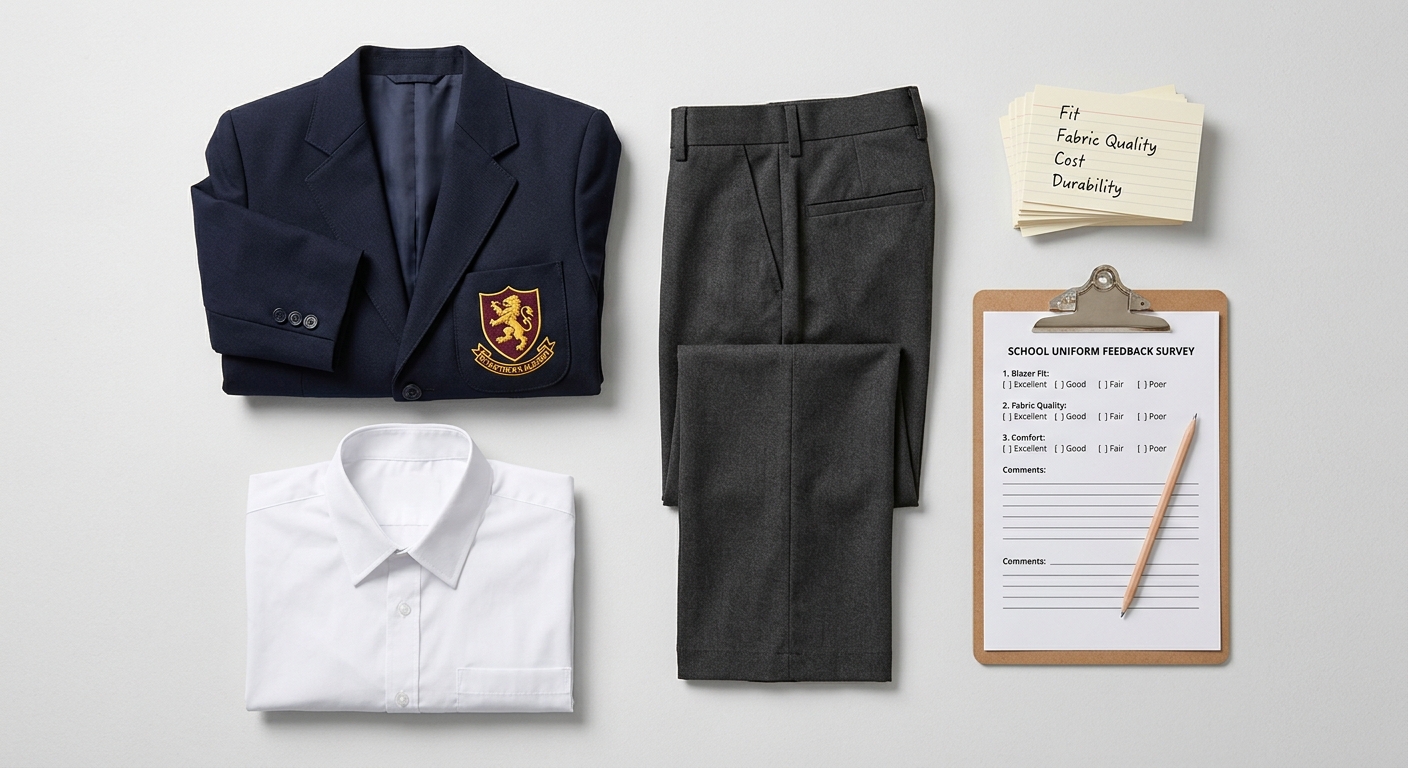
Whose Input Can a School Consider?
Schools typically involve three primary stakeholder groups in a school uniform review. Each group brings a different perspective on what works and what needs to change.
Teaching and Administrative Staff
Staff observe uniform performance daily across classrooms, outdoor activities, and school events.
Relevant staff roles to consult:
- Class teachers (fit and movement during lessons)
- PE and outdoor education staff (fabric performance, layering)
- School administration (uniform policy enforcement, lost-item tracking)
- Pastoral staff (student comfort and self-expression concerns)
Sample discussion questions for staff:
- Which uniform items generate the most complaints or adjustment requests?
- Are there seasonal issues (overheating, insufficient warmth) with current garments?
- Does the current uniform support the range of physical activities students participate in?
- Are there items that wear out faster than expected?
Families and Guardians
Families manage uniform purchasing, laundering, and replacement. Their feedback centers on cost, availability, and practical durability.
Sample survey questions for families:
| Question Category | Example Question |
|---|---|
| Purchase experience | How easy is it to find the correct sizes for your child? |
| Durability | How long do current uniform items typically last before replacement? |
| Cost | Are current uniform costs manageable within your household budget? |
| Fit and comfort | Does your child find the current uniform comfortable to wear all day? |
| Suggestions | Is there any item you would like to see added, removed, or changed? |
Keep family surveys to 8–10 questions. Longer surveys reduce completion rates significantly.
Students
Student input is most useful when focused on comfort, wearability, and day-to-day practicality rather than open-ended style preferences.
Age-appropriate collection methods:
- Primary (ages 5–11): Classroom show-of-hands or simple illustrated choice cards
- Lower secondary (ages 11–14): Short written surveys with 5–6 focused questions
- Upper secondary (ages 14–18): Anonymous digital survey or facilitated group discussion
Sample questions for students:
- Is there anything about your current uniform that makes it hard to move or concentrate?
- Which item do you find most uncomfortable and why?
- If one thing could be improved, what would it be?
Avoid asking students to design the uniform or vote on colors. This creates expectations that may not align with budget, branding, or supplier constraints.
How to Organize Feedback Before a Design Review
Raw responses from multiple groups need structured consolidation before they become useful for a supplier brief.
Categorizing Responses by Theme
Group all feedback into functional categories regardless of source:
| Feedback Theme | Examples |
|---|---|
| Fit and sizing | Waistbands too tight, limited size range, no adjustable options |
| Fabric performance | Fading after washing, poor breathability, pilling |
| Item range | Missing lightweight layer, no weather-appropriate outerwear |
| Cost and availability | Limited stockists, high replacement cost for fast-growing students |
| Aesthetic and identity | Color feels outdated, logo placement inconsistent |
Distinguishing Frequency from Intensity
Not all feedback carries equal weight. A single strongly worded complaint about a safety issue differs from general mild preference.
Useful sorting approach:
- High frequency + high impact: Prioritize in brief (e.g., sizing gaps affecting most students)
- Low frequency + high impact: Flag for investigation (e.g., allergic reaction to fabric)
- High frequency + low impact: Note but deprioritize (e.g., minor color preference)
- Low frequency + low impact: Archive for reference only
Building a Summary Document
Before contacting any supplier, produce a one-page feedback summary covering:
- Total number of respondents per group
- Top 3–5 themes per group
- Any non-negotiable constraints (budget ceiling, existing brand colors, regulatory requirements)
- Open questions requiring supplier input
This document becomes the foundation of a school uniform redesign feedback brief.
How to Communicate Back to Stakeholders
Transparency after feedback collection builds trust and manages expectations before the design phase begins.
Key communication steps:
- Acknowledge receipt: Send a brief message confirming feedback was received and reviewed.
- Share a summary: Publish a short summary of the main themes identified — not individual responses.
- Explain scope: Clarify which suggestions fall within the project scope (e.g., fabric change is feasible; full color change is not due to branding constraints).
- Set a timeline: Communicate when families and staff can expect to see proposed options.
What to avoid:
- Do not imply that all suggestions will be implemented
- Do not share individual responses publicly
- Do not make design commitments before consulting a supplier on feasibility
A short FAQ page on the school website or a newsletter paragraph is sufficient for most school communities. Over-communication at this stage can create premature debates about specific design options.
Practical Use Cases
Case A – Primary school with a single uniform supplier
A 300-student primary school conducts a one-page family survey and a staff discussion session before its 5-year uniform contract renewal. The feedback summary identifies sizing gaps in upper primary girls’ skirts and poor durability in the PE polo. These two issues become the primary brief points for the supplier meeting.
Case B – Secondary school introducing optional items
A secondary school considering adding a lightweight zip-through layer collects student feedback via a 5-question digital survey. Results show strong demand across year groups for a non-branded option. The school uses this data to request both branded and plain versions from three suppliers for cost comparison.
Case C – New school establishing a first uniform
A new school opening in 18 months runs a parent forum and staff workshop to define core values the uniform should reflect (professional, active, inclusive). These qualitative themes are translated into a written design brief before any supplier is contacted.
FAQ
Whose feedback can a school consider before updating a uniform?
Staff, families, and students — each contributing different practical perspectives.
What questions can schools ask families about existing uniforms?
Focus on durability, cost, sizing availability, and daily comfort.
How can schools collect student feedback about uniform choices?
Use age-appropriate formats: illustrated cards for young children, short surveys for older students.
How can feedback be organized before a design review?
Categorize by theme (fit, fabric, cost, range) and sort by frequency and impact.
How can schools explain which suggestions will be considered?
Share a summary of themes and clarify scope constraints before design work begins.
How long should a school uniform feedback process take?
Allow 6–8 weeks from survey distribution to consolidated summary.
Should schools share individual feedback responses publicly?
No — share only aggregated themes to protect respondent privacy.
When is the right time to contact a uniform supplier?
After the feedback summary is complete and a written brief is drafted.
Conclusion
Structured school uniform feedback collection reduces project risk and improves brief quality. The process requires three steps: collect input from staff, families, and students using appropriate formats; consolidate responses into themed categories sorted by frequency and impact; and communicate back to stakeholders with a transparent summary before design work begins.
Schools that complete this process before contacting a supplier arrive with clear priorities, realistic constraints, and documented community input — reducing revision cycles and building confidence in the final outcome.
Recommended next step: Draft a one-page feedback summary template covering stakeholder groups, top themes, constraints, and open questions. Use this document as the starting point for your first supplier conversation.
References and Standards:
- UK Department for Education: School Uniform Guidance (2021, updated 2023)
- National Association of Head Teachers: Uniform Policy Frameworks
- ISO 7176 / EN 13402 – Clothing size designation standards (relevant for inclusive sizing briefs)
- CIPD People Management Guidance: Stakeholder Consultation Best Practice